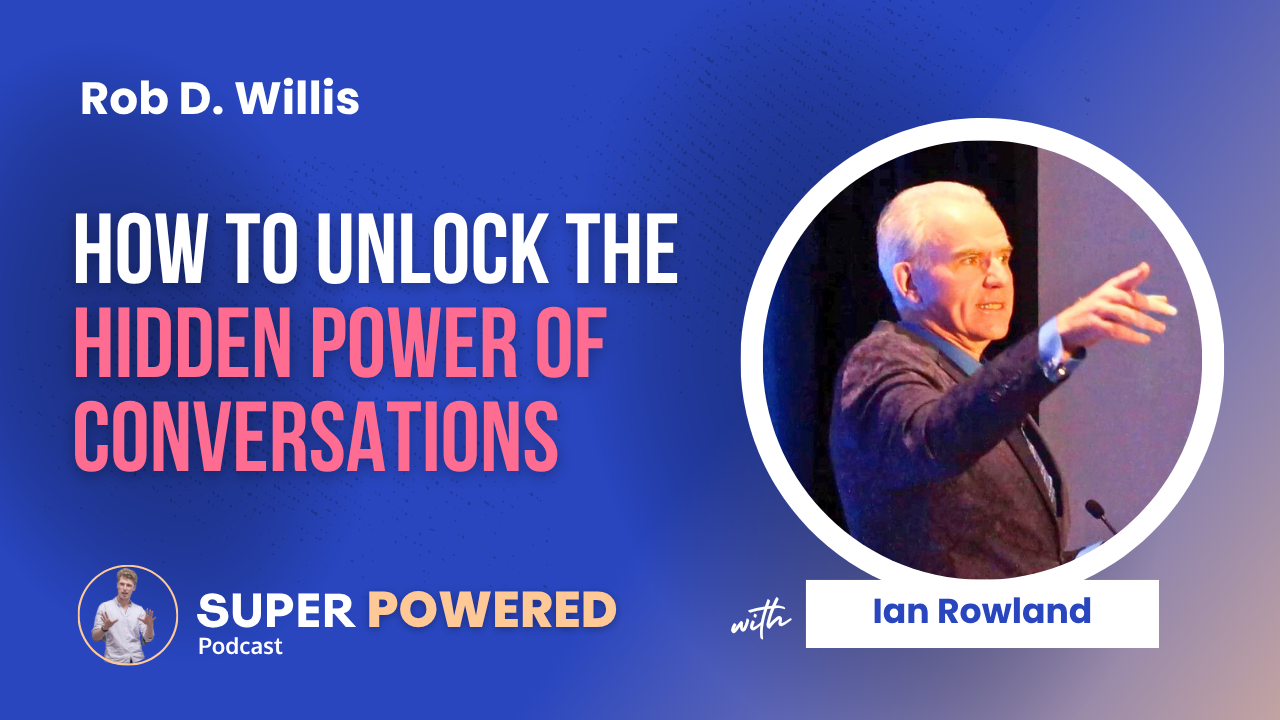
Ever wonder why some people can walk into any room and instantly connect with strangers?
Ian Rowland has spent 40 years mastering this exact skill. As a professional explainer who's worked with everyone from the FBI to Google to Coca-Cola, he's discovered that most of us squander 99% of the potential in our conversations.
From being a member of the Magic Circle to becoming a freelance writer with four decades of experience, Ian understands the power of attention and human connection. His new book "People Joy" reveals the difference between passive autopilot conversations and active, intentional ones that create genuine connections.
This isn't about manipulation or sales tricks—it's about authentic curiosity and generosity that transforms how people feel after meeting you. Ian shares practical frameworks that help you move from overlooked to memorable, whether you're networking, interviewing, or simply ordering coffee.
Key Talking Points:
The three foundations that transform conversations: how you feel about people, yourself, and conversations themselves
- Why "reading the room" isn't mystical—it's 200,000 years of human evolution working for you
- The "10-second smile challenge" that creates practice opportunities with service industry heroes daily
- How genuine appreciation for others naturally leads to unexpected benefits and connections
- The counter-intuitive approach of treating every interaction as a chance to make someone's day better
Links & Resources:
- Ian's Website: ianrowland.com
- Book: "People Joy"
- LinkedIn: Ian Rowland
Today's Exercise: The 10-Second Smile Challenge
This simple practice builds your conversation skills while brightening others' days. It develops your ability to connect authentically and notice the impact of genuine attention.
Steps to Apply:
- Set a mental challenge when meeting someone new or familiar
- Aim to elicit a smile or laugh reflex within the first 10 seconds
- Use genuine warmth, eye contact, and attentive energy
- Keep score throughout your day—how many smiles did you create?
- Start with a goal of three smiles per day
- Practice with service industry workers, colleagues, and strangers
- Focus on authentic appreciation rather than trying to get something
Strategic Storyteller Newsletter:
Ian's approach to genuine curiosity and attention mirrors the power of authentic storytelling in business. For more insights on connecting through stories that create real impact, join my free 'Strategic Storyteller' newsletter at robdwillis.com/newsletter. Each week includes practical storytelling frameworks, personal insights, and curated resources from the podcast—all delivered in a 3-minute read.
Please note : This transcript is automatically generated and provided for your convenience.
[00:00:00]
[00:00:00] Ian Rowland: people are beautifully, endlessly, utterly fascinating
Believe in the greatness of the people you're talking to. You can go into every conversation hoping to achieve a win.
[00:00:15] Rob D. Willis: Welcome to Superpowered with me, Rob d Willis. Each week I talk to leaders from inside and outside the business world about their superpowers, how they got them, and how you can get a bit of them as well. If you're new here, please make sure to subscribe wherever you listen to podcasts.
We have amazing guests. Every week, and today I'm talking to Ian Roland about unlocking the hidden power of conversations. Ian describes himself as a professional explainer, and he's spent 40 plus years helping people communicate more effectively. He's worked with everyone from the FBI to Google to Coca-Cola, and he's also a magician in the Magic Circle. His new book, people Joy Reveals How most of us squander 99% of the [00:01:00] potential in our conversations and tells us a little bit about what we can do instead. Ian, welcome to the show.
[00:01:07] Ian Rowland: Welcome. Yes, indeed. And Thank you for having me. And so, so graciously. Great. I.
[00:01:18] Rob D. Willis: let's dive into this, this core premise that people are squandering
[00:01:22] Ian Rowland: Yes.
[00:01:24] Rob D. Willis: of the potential in their conversations. So what do you mean by that? Can you tell us a little bit about this?
[00:01:29] Ian Rowland: It's just the truth. There's a part that I nearly included in the introduction to the book, although I eventually decided not to. I thought it was a kind of a downbeat to start on. If it's not the case that I go around intentionally eavesdropping on people's conversations but there are many occasions that I quite legitimately am a witness to someone's conversation, whether it's business selling, trying to manage a team trying to perform, trying to entertain, trying to make a connection with a stranger, trying to talk [00:02:00] to someone new, find socially quite interesting, any, or going to a job interview and it doesn't go as well as they hoped.
Afterwards, I, I feel sympathetic. Of course I do, but at the same time, I want to gently shape them by their shoulders and say, how can you be surprised? There was nothing in your eyes. There was no personal I attenti energy. You didn't look happy to see them. You didn't do any voice matching. I mean, there was so much You could have do and, and enjoyed and made a fantastic connection and it was lifeless and you, you looked forward to talk to them, and of course it didn't go well.
And I see this in so many cases, and because of the sort of strength, like different things I've done it just became, it just became something I noticed again and again, and a few people who knew me said, Ian, you've gotta put this all in a book. You've got to, you've gotta share. So here we are.
[00:02:59] Rob D. Willis: [00:03:00] And you make this distinction between passive and active
[00:03:04] Ian Rowland: Yeah.
[00:03:05] Rob D. Willis: conversations. Can you tell us about what, what that means in your
[00:03:09] Ian Rowland: Yeah. With pleasure. Of course we all talk to each other all the time. I, we have conversations social
[00:03:15] Rob D. Willis: have.
[00:03:16] Ian Rowland: professional. But a lot of the time we tend to lapse into the kind of conversational equivalent of autopilot. We're not really thinking about what we're doing, it just happens automatically. So that's what I call a passive conversation because you're not really engaged with it actively and thinking about the situation, Hey, I've got the opportunity here.
To talk to another human being and I can, there's lots of things I can do. To make it clear, I find it's person fascinating. I find them really valuable. I want to make a good connection here. I'm delighted to meet that I can use my eyes, my personal energy, my [00:04:00] attentive energy. I can use my voice well. I can make sure that my sense of personal space is correct.
I can ma, I can breathe. I can give them time to talk and make sure I don't have conversation, and I need my facial expressions and gestures and really make this person feel fantastically important. Most of the time we don't do that. And also, you know, we don't read the room. This person might be could do a little bit of sympathy right now, or maybe they're going through a hard time or that something is a depression or something's happened recently that's put them off, you know, be sensitive to people and understanding and care about.
That's what the difference between passive, where it's just an autopilot and you just talk and some words come your mouth and active and having an active conversation. Does require a little bit more mental energy, a little bit, but if nothing that people can't do, I mean it, it's well winning range. As for the intentionality, the other thing is you raise the second point.
A lot of the [00:05:00] conversation we have people go into them without any given intention, whereas what I say in the book is you can have a lot and you can go into every conversation hoping to achieve a win. That usually takes you know, various forms such as I can go on a mind walk, learn all about this person, or I can give them a bit of validation, sympathy, or listening that they could really use right now, or I could just use this time to make a really good connection that we'll both follow up on afterwards and we'll both be better off for it.
[00:05:30] Rob D. Willis: How do you help someone begin? Bring all of these lessons into how they speak because it, it doesn't come naturally for everyone, I don't think. So do you start with intention or do you start with a particular skill when you are, when you're helping people develop these skills?
I mean.
[00:05:47] Ian Rowland: I start with the. Foundations that you know, are in the book. Foundational one is how you feel about other people. And our starting point there is that people are beautifully, endlessly, [00:06:00] utterly fascinating because they are. And the second foundation is how you feel about yourself, because that's really important.
And the starting point, I, I introduced people to is to kind of mentally not, not out loud. Unless you want funny words, but to mentally say, I'm great and I expect it's pretty great to be you as well. So believe in self greatness, but believe in the greatness of the people you're talking to. And thirdly is how you feel about conversations.
And we, we, we've covered that. You know, do you want to go through the rest of your life having passive, non, non-intentional conversations, or do you want to switch to active and intentional ones? So those are the three foundations. Those are the first three chapters in the book. When I'm working with people on this those are the three places that we start.
[00:06:47] Rob D. Willis: people come to you, what are the kind of challenges they say that they have? Because I imagine they don't see that they're lacking this intentionality or the, the , what's the problem they think they have [00:07:00] basically.
[00:07:00] Ian Rowland: It's it's really the three areas that you would expect. It's true.
that don't. Analyze it in the way that, you know, we've just been talking about and using those headings and those terms of reference. But they will say something like I, I get on well with people at work and, and it's okay. I enjoy my job, but I, I, I get ignored or overlooked or I don't seem to be making the right impression on people, or I just would like to get a bit more outta it.
So sometimes it's word related a lot. It's social related. People see, I don't wanna make this, I don't wanna give you a big
all about me speech, but sometimes people see the way that I interact with others, particularly in the service industries, and that's a big point we ought to talk about. And they, that's afterwards when they tend to kind of take to one side and say, can you teach me how to do that?
Can I learn that trick as well? Because you like connected with that person in 0.3 of a lightning second. [00:08:00] And by the way, that does lead to a lot of purely selfish benefits, discounts, freea, people giving me 10% of blah, blah, blah. I'm not saying that's what a motive we should focus on. It's just an incidental bonus.
So sometimes professional and work related, sometimes it's social, but a lot of the time people realize they do actually realize that they, they're lacking something in the. They want to wonder why they're not more at ease in social situations And why they're not enjoying it much. And they they say, can you help me with that? I, say, you absolutely I can.
[00:08:38] Rob D. Willis: Could you take us through maybe one, an example of that, one of your favorite mind walks?
[00:08:45] Ian Rowland: I was Las Vegas. I took a taxi. I, and that's the kind of time when you don't need to have a conversation at all. I mean, you can just sit in the back of the taxi, right? So I got talking to this guy, he's of Greek descent Greek [00:09:00] ethnicity, and he was in his business and he was telling me about his family history before the second World War I family in Greece ran a preface metals business. They bought and sold gold and things like that. The war came along and they decided to immigrate to America and they had to get themselves, but also all of their stock, all of their precious metals and everything else they owed across to America without being stock or intercepted or caught, and they managed it.
Now that's a story. It's an amazing Background.
story, why would you not want to listen to that?
[00:09:42] Rob D. Willis: So how do you engineer, or is it possible to get to those amazing stories kind of intentionally? Because I'm guessing you didn't sit down in the cab and say, yo, so tell me about how your family escaped the [00:10:00] Nazis and got to America.
[00:10:01] Ian Rowland: Just keep your eyes and ears open and remind yourself you're talking to a ING human Again, it goes back to attentive energy, eyes open, ears, open mind in gear, not on autopilot, and say, there's going to be something utterly fascinating about this person.
Just let. The, and let's wait until we, something interesting. Ask about,
[00:10:24] Rob D. Willis: the, the technique you describe it, it's at its core, so utterly simple. It's all about attention, just giving full attention, and I. Being confident that something interesting, something wonderful is gonna come out of this And I know you you are a magician, and so you understand the idea of attention, use it in misdirection, and it, it's one of the key skills, isn't it? What has taught you about creating these amazing conversations, would you say?[00:11:00]
[00:11:00] Ian Rowland: The Ari pla lots of parallels. So just a mild clarification. This isn't my job. I'm not, and never have been a professional magician, but I'm a a keen Amateur.
and yes, I mean, I've performed magic and mentalism shows. That's the kind of magic that looks like mind for listeners in the UK with the work of Darren Brown.
He's a friend of mine, that sort of thing is what we call mentalism. So I am a member of the Magic Circle. Many of my friends are performers and entertainers of various kinds. So the, the parallels between magic and what we're talking about are quite profound. Actually. There is a thing that all performers, including magicians, are doing every second of every live performance.
We call it read the root. But there is an awful lot of attentive energy involved scanning the audience, making eye contact even as, even as briefly with everybody that you are performing in front of. And [00:12:00] again, just keeping your mind in active gear, keeping your eyes and ears open and paying attention.
You have to put in some serious flying time to get this to work correctly. But when you get there, it's transformative. It makes you a much better performer and it means people enjoy your shows more. So you both win both the performer and the audience win from this.
[00:12:22] Rob D. Willis: This definitely resonates with me both from my time when I was working as a tour guide and then also. Now more in the world of facilitation and training and so
[00:12:33] Ian Rowland: Yeah. Yeah.
[00:12:34] Rob D. Willis: at the beginning, you are so worried about getting it right that you've not got the spare capacity to notice these things, but through the repetitions, then you've got more of that space and then you can really begin to pay attention to people.
Are there maybe any shortcuts that you can see for people? Maybe they not quite there in terms of having mastered their craft, but there are a couple of things they'd like to look out for when they are [00:13:00] reading the room. Is it a feeling, is it something you kind of find intuitively or are there any particular body language signals, way people speak, et cetera, that you particularly look out for
[00:13:12] Ian Rowland: First of all, I think perform as an entertainers you, you start learning to trust your innate instincts. Now look, we're all the products over a couple of hundred thousand years of evolution. We are social, gregarious breaches.
We've learned to pick up a lot about other people. Are they feeling engaged? Are they feeling happy with this? Do they like this? Are they not? It's not difficult to get the vibe whether somebody they joined us or not enjoying it so much or they're feeling bored or, or whatever. I mean, we've all got a couple of hundred thousand years of evolution working for us.
So use it and trust your gut instinct and also go be afraid to actually interact with it and say, excuse me. You know, [00:14:00] it, it seems to me that I'm not really landing this for you or it's not really what, what, what's the problem? I'm not saying that I would do that during a live performance, but informally conversations, sometimes it's perfectly alright, right?
To ask a question. It's perfectly okay to check, check in with the other person and say, so this doesn't seem to be going very well. Where am I taken the wrong step if I misunderstood something? And you can do that. But learn to trust your instinct so long as you're in switched on mode. Got your eyes and ears open.
Your mind is active. You wanna pay attention to people and you trust your own instincts. You won't go, you won't go far wrong. Where we've got a lot more awareness about other people than we often realize, and it's just a case of making use of it and putting it to the.
[00:14:44] Rob D. Willis: How do you tune into this intuition and awareness before either a performance, a training, a keynote? Have you got a ritual or is it just something that comes to you quite naturally?
[00:14:59] Ian Rowland: don't have a [00:15:00] ritual now, but then again, I'm an ancient person and everything I do, I've been doing for decades now. I be fairly automatic. I think when you're starting out. Actually you, you touched on an interesting point, which is the power of ritual. And if you want to go through a little ritual that you create yourself saying this thing that's coming up, whether it's a conversation, an interview, a performance, whatever, a sales pitch, whatever, I am going to stay in active mode.
I am going to look, I am going to listen, I am going to notice and I'm going to respond. I am not going to drift into autopilot. I'm gonna treat this person with a fascinating and love and respect that they deserve. I'm gonna look for points of connection. I'm gonna celebrate them while I notice them, and I'm gonna be attentive and responsive.
If you want to make that into a level ritual or man that you go through, hey, go for it. It, it's not gonna make anything worse. It will [00:16:00] make everything better. I think the other thing is, and this is a major point, Lee, which I, you're gonna have to re me in because otherwise this will go on for 10 hours.
You can practice as much as you want. Practice makes perfect, right? You can practice as much as you want with all of the heroes, and I use that sound to me, men and women, all of the heroes who work in the service industries, that's when you can get your flying pilot. That's when you can practice. That person who served for your coffee, checks you in at the hotel, checks you in at the airport, delivers something to your home, whatever.
All of these scars, these amazing people in the service industries, can you elicit a smile? Give yourself that ten second challenge. Can you elicit a smile? Can you make their day better for having met you than it was before? And if you rise to that challenge, it will change your life. I can give you so many stories.
It will [00:17:00] change your life, and then you use that skill in other conversations that perhaps are a bit more important or more significant to you. But they are your free practice hours. Free practice.
[00:17:12] Rob D. Willis: Let's stick with this, actually, because I was gonna ask about it anyway. You told me the story of getting a quote unquote proper table in London
[00:17:21] Ian Rowland: Yes.
[00:17:21] Rob D. Willis: couldn't tell us a little bit about what happened there and what's happening in these interactions that people can learn from.
[00:17:31] Ian Rowland: Okay. I need to just insert one caveat. We are going to get onto the subject of just when this pays off in some material way, like you get a, you get a special offer or a pre discount or 10% off this or a pre drink. This is not the reason to to it, but it's an incidental benefit. Of doing it, which isn't, it's, it's quite nice.
So the story that I mentioned I was due in London to meet up with, it was street television [00:18:00] people. Actually. They wanted a bit of input on the new project and we had chosen the venue to meet just via Victoria Station. Very nice place where the area is sort of divided into two ones. You've kind of standard restaurant table.
And there's another area near the bar where just kind of high stool and some elevated tables. We, it's more like a perch. The the table really. And I got there. The other three were already there, and they were all one of these rather cramped, awkward high tables, which were not, it wasn't really suitable for our purpose because we were gonna be getting out scripts and things, and I had things to show them I was gonna give some of their tarot reading and blah, blah, blah.
I said that I, you know, we did the meet and greets and I said, how come we're over here? And the, the one of the other three guys said, oh, well, we did ask about sitting in that section, so obviously we'd be more comfortable, but we were told that's not allowed [00:19:00] because we're not here for a meal. And I said, okay.
So I went and found one of the members of Sparkler and I talked to him and I connected with him and I asked him. We got one of the proper tables inside. Two minutes, we have a sat down there, and not only will we have here, this is the important thing now, rain will we have here because we have this, as I say, as I described it to you, top the table where we could actually lay stuff out and look at scripts and things.
So it was more comfortable and and suitable for us. But that member of staff was happier as well. He felt better off because he'd done something really nice today. And we had just, we were there hours on end and we interacted with that member of staff many times and we made, made it, made him feel good and made him aware of how much we appreciated what he'd done for us.
And that happens to me on a daily basis.
[00:19:57] Rob D. Willis: In this quick two minute [00:20:00] interaction where you, I know it shouldn't be the, the reason that we try and develop this this practice, but you had a particular intention, which is you wanted to get a quote unquote proper table. So what are you looking to do in. A short interaction like that to elicit that kind of positive response.
[00:20:22] Ian Rowland: I found this man who worked as a sort of a wait also generally. Had some kind of supervisory role in the restaurant section, and I went up to him with proper use of space and, and physical connection. I, I showed him love and interest and warmth and appreciation. He's doing a difficult job, and not only is that, it's one that most people take for granted.
People, they just ignore it. They don't really pay any attention and I, I communicated with my eyes, my body language, my energy. How fascinating I was to meet [00:21:00] him, how interesting he is and how much I appreciate the difficulties of this job, but also the rewards of it. And I, I communicated all of this just with my manner because it, and this was the thing, this is genuine.
This is really what I felt about this done. And I understood that he had some rules and regulations he was supposed to observe, and I understood that they have this distinction between. People who get down because they're gonna award lots of food and have a proper sit down meal. And people who aren't, I understood it, but I just engaged and said, look, I'm here meeting these three.
We'd really like to sit at one of these tables. I know you're supposed to just, they are reserved, but, but you're not totally d It's not a bit a place's crowded. Just on this occasion, do you, would it be possible? I mean, it would really help me and we are going to order some things. We're gonna be here for a few, a few hours.
I mean, could you make an exception on this occasion? I mean, if you can't that's fine. [00:22:00] We, we'll stay here, but I just wondered if on this occasion, and we've gotta table, but it wasn't, it wasn't sort ofmy trying to charm my way in. I genuinely appreciated the work that this man and. And wanted to show him from appreciation and he, of course, he got, he got the opportunity to be a hero.
He got the opportunity to be a Superman, to be the person who makes a nice thing happen for four guests. So he didn't have that before. Now I've given him that opportunity and we showed him love and thanks and appreciation all Ackerman.
[00:22:35] Rob D. Willis: It's, it's funny you are reminding me of another conversation on this podcast about something completely different, it was a guy who writes about strategy and he was saying that superpower really is to have an opinion and to have views. And what people should do is they should start writing and sharing their opinions, but don't do it as marketing minute you try and get something [00:23:00] out of it. It loses the authenticity.
[00:23:02] Ian Rowland: Right.
[00:23:03] Rob D. Willis: be writing almost exactly the same words, but people feel that it's for your personal gain,
[00:23:09] Ian Rowland: Right.
[00:23:10] Rob D. Willis: that's kind of what I'm getting from this. It's an internal shift, a genuine generosity, a genuine curiosity. That is how we connect with people, or at least it seems in this particular
[00:23:22] Ian Rowland: yeah, it, it has to be authentic. And I'm talking this way about people because.
Some people, I know that you are very interested, for example, in our ability to influence one another, and of course lots of people are if you work in sales or similar roles that's a part of it. Or, or if you just like the idea of getting free upgrades and free what, which happens to me all the time.
I get free stuff in shop, in stores, and. If you're nakedly, selfish, not interested in that. Okay. You know, do it for that reason if you want to, but for me, that's just an [00:24:00] incidental benefit. It's nothing, it's not the main thrust of it. I, this is how I actually feel about people. And I particularly feel it about all these heroes in the service industry because they sometimes do get a raw deal.
There are people who look down on them. There are people who just treat them like dirt or take them for granted. It's not nice. It's really not nice and it's not right. And these people they are heroes and they're putting in long hours. Most of them are not well paid for what they do. Show them some love, show them some appreciation, respect them as people, and you're making more smiles appear in the world, and that's what we should be doing.
[00:24:38] Rob D. Willis: Let's go on to the listener challenge then, and in this part of the pod, we give listeners a ritual or an exercise, something they can try out over the next week to get a little bit of your superpower. Ian, what have you got for us?
[00:24:51] Ian Rowland: It's a very simple one. As you know there's a whole.
And it's very simple. When you meet somebody, when you're talking to people whether it's for the first, [00:25:00] especially for the first time, but you can use this with people you already know. Set yourself a little mental challenge. This isn't something you talk about. It's just in turn you say, can I elicit a smile or a laughter reflux within the first 10 seconds or so, don't stopwatch.
Fairly through within the conversation. Can you elicit the smile or lap reflux? It's a beautiful thing to do and give yourself a score during the Day You know, when you sort of get to the end of the day, how many smiles did I create in the world today that weren't there before? and you can do this with people.
Meet for the first hot. You can do it with people you already know. You can do it. As I say, with all the beautiful heroes of the service industries. Hot. You can do it with people you just pass in the street. People on the bus, people on the track. How many times can I elicit a smile or a, but how many smiles can I [00:26:00] create today in the world that weren't there before?
And I'm not trying to get all heavy and method physical about this. I'm not that kind of person. But just imagine if we all focused on that. Just imagine the world we'd be in if we all focused on trying to. Share a smile and, and, and create those warm feelings, those loving feelings in one another. My word, what?
You know, what a world it would be. So the the challenge is the ten second smile. Set yourself that task. Make that much effort. 'cause people are worth it. Can I elicit the smile or love the reflex? And how many times a day can I do that? You know, a aim low, just go for three, three a day. It's not difficult.
You can get there three times a day. And just work. up from there.
[00:26:47] Rob D. Willis: What a lovely idea to to take into the next week. Ian, where can people go to find out more about you?
[00:26:53] Ian Rowland: Roland.com would be a good start, I suppose. But I do have a cheeky answer to that as [00:27:00] well, which is there's only some much you can bleed from a website. And of course my website is mainly, it's mainly work focus. And in case for this, for that. A really simple way. It's probably not the answer you want to kick about but I say just write to me.
I love meeting and hearing from new people. Drop me a little email, ask a question. I'll write back to you. I'll talk to everybody. I love meeting people and if I meet them through the medium of email or people contact me through Facebook Messenger or whatever, WhatsApp. So I'm probably not the right answer you to, but yeah.
I mean they can look at my com if they the book, but me,
[00:27:38] Rob D. Willis: We will be sure to link to your website. Maybe we won't give your phone number away, but
[00:27:43] Ian Rowland: maybe not, maybe not,
[00:27:44] Rob D. Willis: but we'll definitely link to your, your book as well., Ian, it's been such a pleasure talking to you.
Thank you so much.
[00:27:49] Ian Rowland: Thank you for your time.
[00:28:00] [00:29:00]
Subscribe to the Podcast!