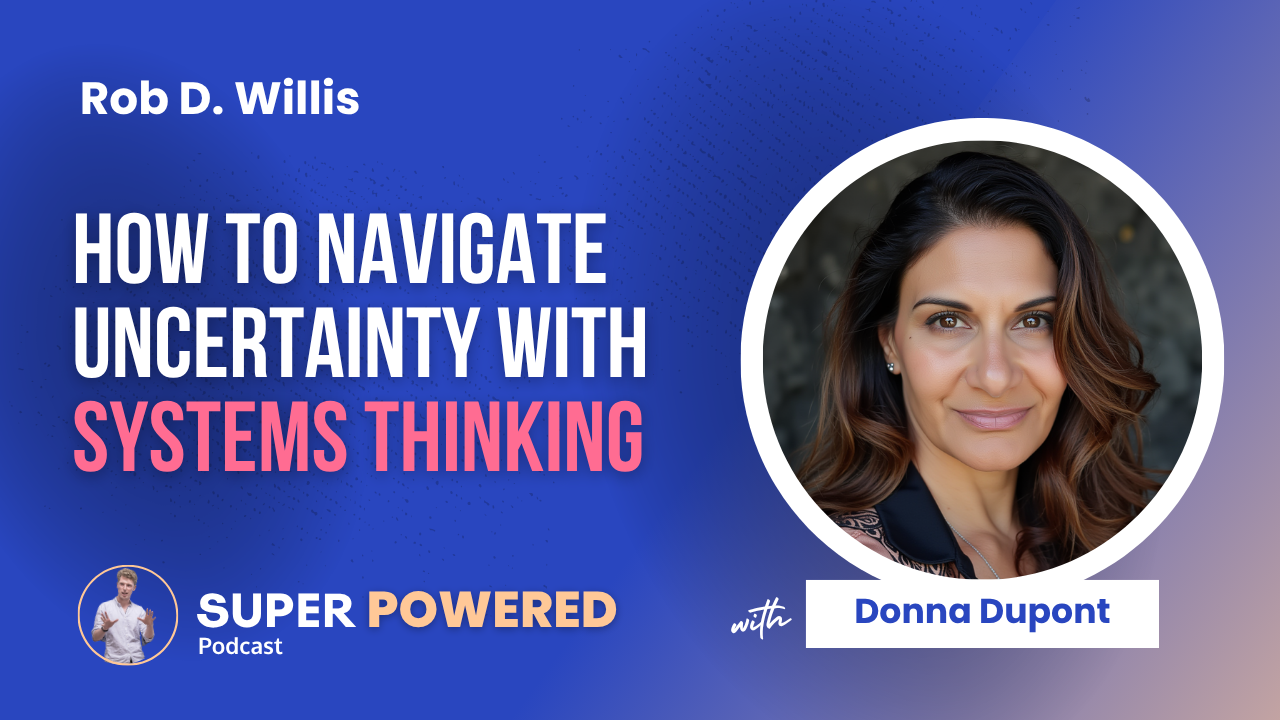
Ever feel overwhelmed when everything seems to be changing at once?
Donna Dupont transforms that chaos into clarity using systems thinking. She spots patterns others miss and finds leverage points in complex situations that can transform how leaders make decisions under uncertainty.
With over 25 years helping organisations navigate complexity—from H1N1 and Ebola responses to NATO climate security projects—Donna brings battle-tested frameworks from the front lines of crisis management. She's won 7 government awards for excellence in policy and strategic planning, plus recognition for her award-winning research on "Anticipation in Emergency Management."
This isn't just theory though. Donna openly shares how she went from being naturally anxious to building comfort with uncertainty through deliberate practice. Her practical approach to breaking free from mental prisons will change how you see challenges and opportunities around you.
Key Talking Points:
- The "boundary principle" that prevents teams getting lost in complex systems—and why one military syndicate succeeded whilst another struggled without it
- How to take inventory of your discomfort zones and identify three key drivers of change that concern you most
- The counter-intuitive reason to share extreme scenarios—not because you believe they'll happen, but to surface hidden assumptions about the future
- Why anticipation in emergency management was just 24-48 hours, but extending time horizons could prevent repetitive crises
- The mindset assessment that determines whether teams focus on threat mitigation or opportunity leverage
Links & Resources:
- Donna's website: purplecompass.ca
- LinkedIn: Donna Dupont
- Book recommendation: "Thinking in Systems" by Donella Meadows
Today's Exercise: The Systems Pattern Scanner
This practice helps you identify hidden patterns and feedback loops in your personal or professional challenges. It builds awareness of what drives complexity whilst revealing potential intervention points.
Steps to Apply:
- Choose one turbulent situation in your life (start small, not global challenges)
- Ask: What's driving this pattern's growth or persistence?
- Identify potential cascading consequences if it continues
- Explore: Can you slow down what's driving it?
- Consider: How might you mitigate the consequences to bring more balance?
- Look for feedback loops—where effects become new causes
- Practice this lens weekly until systems thinking becomes natural
Strategic Storyteller Newsletter:
This episode explores how mental models shape what we see as possible futures—and how challenging those assumptions opens new strategic options. For more insights on breaking limiting beliefs and reframing complex challenges, join my free 'Strategic Storyteller' newsletter at robdwillis.com/newsletter. Each week includes practical storytelling frameworks, personal insights, and curated resources from the podcast—all delivered in a 3-minute read.
Please note : This transcript is automatically generated and provided for your convenience.
[00:00:00]
[00:00:00] Donna Dupont: Systems thinking is asking you to take more of a mountaintop 30,000 view perspective. 'cause that's the first principle of systems thinking is
Know your boundary, know your frame so you don't get lost in your system.
[00:00:16] Rob D. Willis: Welcome to Superpower with me, Rob d Willis. Each week I talk to leaders about their superpowers, how they got them, and how you can get a bit of them as well. If you're new here, please make sure to subscribe wherever you listen to podcasts. We have amazing guests every week, and today I'm talking to Donna DuPont about how to navigate uncertainty with systems, thinking this is a skill that's become.
Absolutely critical in today's world, whether you're dealing with supply chain disruptions, team changes, or market volatility, the ability to see pattern and find leverage points in complex situations can really transform how you lead and make decisions. And Donna brings a fascinating perspective to this challenge.
She spent [00:01:00] 25 years helping organizations. Navigate complexity and uncertainty from healthcare emergencies to international security challenges. Her work spans everything from H one N one and Ebola responses to NATO climate security projects, and she's developed award-winning research on anticipation in emergency management.
Donna, welcome to the show.
[00:01:21] Donna Dupont: you, Rob, for the opportunity to appear on your podcast.
[00:01:24] Rob D. Willis: In your own words, could you tell people a little bit about who you are and how you help people?
[00:01:29] Donna Dupont: Well simply put, I'm a foresight and design strategist, and I tend to use that term strategist because I think of things from a strategic orientation. I help my clients navigate complexity. I. And uncertainty of today's world. And I was drawn into this type of work just with a lot of the global challenges, wicked problems that have been evolving over the last, like many, many years. and [00:02:00] so the types of clients I work with are those that are really trying to build the skill. how do we navigate, how do we build a skill around understanding complexity, understanding systems, and how do we anticipate going forward? And the reason is to be able to make sense and to have good insights for decision making for the future.
[00:02:25] Rob D. Willis: and systems thinking is a big part of that. For listeners less familiar with systems thinking, could you just define it in your own words and maybe tell us a bit how it's useful for dealing with uncertainty? I.
[00:02:39] Donna Dupont: Systems thinking simply put is trying to understand things at a holistic level. So I know that's a word that it gets used a lot, but what that means is it's about perspective. Often in our day-to-day world, we are dealing with [00:03:00] a lot of issues and our lens, our world can be very small, right? In terms of what we, how we think about our space or our surroundings. Systems thinking is asking you to take your perspective from maybe the day to day, you know, to more of a mountaintop 30,000 view perspective. To see the broader changes. Now you don't have to go that high. You can go somewhere in the middle, but it's about expanding and moving up the perspective of what you're seeing.
So getting on top of whatever challenge or issue and stepping outside of it to understand the patterns and ask very important questions about what you're observing.
[00:03:43] Rob D. Willis: Then just to put this, make this more tangible for everyone, have you got an example of a team that you took through this process?
[00:03:52] Donna Dupont: Some of my best examples from the time when I was a facilitator and an instructor at [00:04:00] the Canadian Forces College in Toronto. so just for your audience, this is a staff military college. So it's for military senior military officers to come to the college and develop new skills to move up in the ranks.
And from the pool of lieutenant Colonels will emerge the next generals of our country. So, so it's a very interesting space where you have a lot of. New opportunities to learn different skill sets. One of the different streams was around design, so foresight and design. And these were opportunities for me to come in as, as an external facilitator, but to lead. These syndicates and they would be 12 a, a minimum 12 to a syndicated of lieutenant colonel. Sometimes I had to lead a unit, which would be three syndicates. what you're doing is you're leading through a [00:05:00] complex exercise, so we would make it an exercise. I would recreate what I would imagine as a future intelligence lab. And, and so the idea was to look at the complex challenge and being able to use some of these tools coming from systems thinking coming from futures thinking to be able to make sense of the complexity, to understand where we wanna focus our lens in the system. Where we think there's value to go a bit deeper into understanding the root causes of some of these issues, but also to, to think about how we can anticipate what, what's changing and how we may need to shift. and so of the best exercises are with these teams because this was a very new skillset for these professionals that are amazing at tactical and operational planning. [00:06:00] And, and so it's really challenging them to, to think beyond their traditional planning models and to start to break those official patterns that we already know what the problem is to, are we solving the right problem?
Are we seeing from the right perspective, right? Because perspective and understanding of the problem. It be can radically change, radically change how we envision solutions.
[00:06:32] Rob D. Willis: And with this, are you using real world scenarios or are you making like scenarios up that they then work upon? What was the sort of ground zero that you were starting out with? Exercise? I.
[00:06:47] Donna Dupont: exercise typically was. organized by the college and they had a, they had an external departments coming from the Department of National [00:07:00] Defense that would sponsor challenges, real world challenges, that they need teams to do some deeper thinking. So we weren't coming with, like, they weren't, we weren't being given a scenario.
We were begi just given a challenge, a complex wicked challenge, and we had to. Decide which tools and how we want it to unpack it and what lens, you know, where we want it to focus in on that particular space. Because with these wicked problems, there's, there's so many different challenges. You need to put a boundary about where you wanna explore, right?
And then be able to make sense with all your tools. So each exercise was different in the sense that it depended what we wanted to explore. And that was typically a decision by the team around. And then we would select the right tool to be able to capture new insights. But some tools didn't work very well, so [00:08:00] I was open to if the tool to not give you a new insight, then it's probably not the right tool and try something different. so it, it allowed us to play and to understand how these tools. It's not just about plugging it in to get an output, it's about how it's shifting your understanding of the problem and giving you new insights that you could scaffold make sense of the landscape.
[00:08:29] Rob D. Willis: And tell me, can you remember a particularly wicked problem and what made it so wicked?
[00:08:38] Donna Dupont: Say all of the. All of the challenges that we were given were all really wicked. But I will use one example of an Arctic exercise. It was a five day military arctic exercise. And if you are familiar with the Arctic environment, there are a lot of moving [00:09:00] parts, a lot of complexities. There's. You know, geopolitical, there's environmental, there's economic, there's border security. You know, right now it's, there's a lot of attention on, you know, just the civilian aspect as well, and, and you know, the geopolitics around the economic and, and also resources, you know, things like that. So
[00:09:22] Rob D. Willis: Mm-hmm.
[00:09:22] Donna Dupont: a lot of moving parts.
And what makes it wicked is that. They're all, all of these parts of the system, there's, there's interdependencies. And so you need to understand what it is that you wanna learn about the system, right? To know where to focus your lens. And what I love about this one particular exercise that the military ran street three streams of syndicates, each focusing on the same challenge, but different approaches. And one of the biggest questions we had before we jumped into the exercise because we knew it was a really complex system, [00:10:00] was whether or not we were gonna put a boundary around what we were gonna look at. 'cause that's the first principle of systems thinking is know your boundary, know your frame so you don't get lost in your system. Right? one team, my team, we decided to put a boundary, you know, on certain parts that we, we knew were a problem. You know, and we want to do a deeper dive, and another team didn't. And, and so the challenge with not putting a boundary around a complex system that your lens, your eyes are all over the place. You don't have focus, And so your tension is going. Out and it's diffuse and you're not cons, you're not bringing in your lens, your power, your focus, and, and you're not building the insight. So my team, we did it together. We worked on a, a really complex problem and we looked at different components of the system and we [00:11:00] did a deep dive together as a, a collective of 12 because each of us had different pieces of knowledge and understanding. Of that system, whereas the other syndicate did it independently and they didn't put a boundary. And, and so the difference was the one team had really diffuse insights, whereas for us, we had more concrete insights and it didn't feel as challenging. 'cause we did it together as a team shared the burden of trying to navigate the complexity together. So,
[00:11:34] Rob D. Willis: Yeah.
[00:11:34] Donna Dupont: the difference, right? Is, is. You know, a system that is just that complex and having the ability to, to navigate it, not independently alone, but as a team making sense of it together and leveraging the intelligence across a diverse group of people.
[00:11:56] Rob D. Willis: Say that there's a, a leader out there and [00:12:00] their industry is being disrupted, how would you recommend that they go about this exercise? So for instance, just the early framing part. Is that something, do you find people can go with instinct or are there particular steps that you would recommend they would use to get started in this process?
[00:12:18] Donna Dupont: So there's different, there's different ways you can approach it. way we did it is just one example, but I would probably, I would recommend that leaders first just. Take inventory of, of kind of where they feel comfortable and where the discomfort is, right. In what they're exploring. Oftentimes, leaders are really thinking about it from their organizational point of view.
So I would just start with that. And then from there, you know, then you can start to ask different questions about,
[00:12:59] Rob D. Willis: Mm-hmm.[00:13:00]
[00:13:00] Donna Dupont: what. What's changing? So perhaps you wanna identify three drivers, right? These are big drivers of trends of change are moving quickly, that you are concerned about, And what is the concern, right?
And, and where is the uncertainty? So I, I would probably start there, and then from there, that will give you a little bit of a frame. In terms of where you may want to as a starting point, focus your lens. And I always like to start with kind of just the primary, you know, areas of interest. And then as you explore, you can always level up as you develop new insights, you can expand the boundaries of your system, but it's better to just keep it nice and, know.
I a little bit because this way then you can go do a deeper dive and you can get [00:14:00] good insights and then you can expand in different areas.
[00:14:04] Rob D. Willis: I'm always a huge fan of questions and I'm wondering what questions would you be asking your team during this process
[00:14:15] Donna Dupont: The first question before I even get into an exercise like this is I always wanna know where their mindset is around the future relationship to the future, that is critical, because a mindset will determine what gets ideas get elevated, or what ideas get eliminated. And so there are different ways to, to approach that. But I, I just as a simple exercise, as an opening exercise, I like to know, of all, what's their orientation? Do they, are they more optimistic or are they more on the negative side? And you know, and it's no judgment here, but it's [00:15:00] just to understand their orientation. Because you know, if you're more on the negative side, you might be looking at more of a risk mitigation, threat lens, more protection point of view. If you're more on the optimistic side, you might be looking at it that, okay, yes, we need to mitigate things, but, but there might be some new opportunities that we wanna leverage that can change the game of how we operate. and so we
[00:15:24] Rob D. Willis: Yeah.
[00:15:24] Donna Dupont: what, what strength we have. That we can leverage a tool or something new that can give us an advantage. So that that's, that's that, that that that's a very different outlook and how you see the future and how you might, that mindset will shift your thinking.
[00:15:43] Rob D. Willis: I'd love to talk about anticipatory governance, and. I'm wondering how can leaders start to build this capability in just to the day to day?
[00:15:52] Donna Dupont: So as a day-to-day, it's, it starts with embracing. [00:16:00] Starting to build the foundations of futures thinking in your organization, And so that can look very simp simple to start in terms of what it means to be future oriented or future ready or leading through complexity and certainty in practical ways. And you wanna be able to see this not just at a program level. you wanna see that change happening and championing at the leadership level, And where it's embracing new ideas, but new ideas to learn. it's a learning mindset, right? and you wanna learn what's changing. that would be the first step, is those foundational, building that foundational. Element where you have someone championing this type of thinking in the organization [00:17:00] and creating a safe space to think in this way. It's very important. And the second would be to, to have a practice. You know, and it can be very simple where you are observing. What is shifting in your environment? And it can be simple, like you can look at maybe you're most interested in the political and economic shifts because those have the biggest impact on your operations. You might want to look at through those lenses and see, okay, what are some subtle things, weak signals that change, background shifts that are happening that if those continue to grow. Potentially could be very It could be disruptive, it could change the way we operate, you know, so it's, it's starting to notice these things and recording them. Yeah. Also, what are some new emerging [00:18:00] issues that we've never experienced before? We have no evidence of how to forecast or to project what to expect.
Right? And, and what are some of the complexity around these emerging issues that we've never experienced before. So by starting to document these, you can then have check-ins with your team do brainstorming sessions around some of these that. Could be significant. And this is where you start to build a culture of anticipatory thinking.
And so the governance aspect is a more formalized process where this is embedded into strategy or to inform policies or innovation or investment.
[00:18:46] Rob D. Willis: Let's talk a little bit about your own history, because you've worked on in your healthcare background from.
Pandemic uh, responses. You've worked in native security projects, and I'd love to hear about what you've learned about [00:19:00] human behavior under extreme uncertainty, which applies to more kind of mundane situations that you're facing with companies today.
[00:19:10] Donna Dupont: So what I've observed. In of my projects, especially because a lot of my clients are more, they come from traditional organizations where they have more of the classic approach to planning for the future or thinking about the future. Very evidence informed, very risk oriented very much outcome, like wanting to know the outcome, you know, type of orientation. What I've observed is that, and this is true of just the human condition, is that when you are faced with complexity and uncertainty, it's, it's very difficult for us to, to make sense of it. And it's, it's very uncomfortable and, and we want clarity. We wanna move away. [00:20:00] From the discomfort and we, we end up shifting to what we're familiar with and what we know, and we hang onto that and we, we move away from it.
And for people that want to do foresight exercises, sometimes when you go into spaces are changing, they'll, they'll fight. That scenario or they'll fight that change or they'll wanna know the evidence around it. And even if it's just a small, subtle signal of change, they'll fight against it. And it's really interesting behavior because that kind of reaction showcases their mental model of what their understanding, their worldview and what they believe to be true about the future. And oftentimes that's hidden very deep. And, and so a lot of times what I try to do is I, I really step back and try to [00:21:00] understand, you know, what's their comfort with uncertainty, you know sometimes you want to
[00:21:06] Rob D. Willis: You want.
[00:21:07] Donna Dupont: something a little bit more radically, extreme, not because you believe that's gonna happen, but you want to see the reaction because you wanna surface their assumptions. the future. And once you get those to the surface, then you wanna challenge them, right? And once you start to unpack and challenge those assumptions, then hopefully you start to open up their mental model and their mindset about what they think is true or what's changing. And so it, it, it's,
[00:21:42] Rob D. Willis: Mm-hmm.
[00:21:42] Donna Dupont: a safe space for these types of conversations. And, and that's not always an option in organizations.
[00:21:52] Rob D. Willis: Is this sometimes the kind of thing you have to do with yourself as well? 'cause I can imagine, you know, we're [00:22:00] all facing uncertainty. And the challenge is you've got the panic, amygdala stress response that we, we've spoken about and not everyone, I imagine this is a practice, put it that way.
[00:22:14] Donna Dupont: discipline. It's a practice, it's habits, it's cultivating it and catching yourself. So this is why awareness of your, your mindset towards the future, the way you think, your emotions, this is very important. The mental model side is very,
[00:22:32] Rob D. Willis: Mm-hmm.
[00:22:33] Donna Dupont: And more that you're aware, then you'll catch yourself when when you're, maybe, when something stimulates you and it will. That takes you down a bit of a rabbit hole, an emotional rabbit hole, and recognizing that is the first step to pulling yourself out of it quicker.
[00:22:51] Rob D. Willis: How did you develop this comfort with the unknown and uncertainty? Is this something you've just always had or. Did was, [00:23:00] do you feel that there was a moment where you began to deal with it better?
[00:23:05] Donna Dupont: This was not a natural, I had to learn this. I definitely had to learn this. I, I was, I would say I was always a little anxious. S up, and, and I had a very interesting career path for someone who was a little bit more anxious. I chose trauma and critical care. I chose emergency management. I chose, you know a futures profession working with uncertainty.
I think there was a part of me that really wanted to have an impact, wanted to help people and make a difference. And, and the uncertainty piece when. When I was working in emergency management in that field I worked for the Province of Ontario, the Ministry of Health, and it was a wonderful experience because I got to see from a systems view, emergencies, you know, and, and the [00:24:00] response to it. And, and the challenges of trying to anticipate in a chaotic environment. And at that time, anticipation for us was very short. Like the time
[00:24:12] Rob D. Willis: Mm-hmm.
[00:24:13] Donna Dupont: was the next 24 to 48 hours and the objective was so that we can make decisions for logistics or operations and what people needed for safety. Right?
And so, but for me, you know, seeing the patterns of repetitive emergencies, I started to think if we can anticipate in longer time horizons. understand things from a bigger picture. We could make better decisions and maybe we don't have to respond often to all of these, these issues and these emergencies, if we could redress the vulnerabilities.
So that's where it came from. for me,
[00:24:54] Rob D. Willis: Hmm.
[00:24:54] Donna Dupont: a lot of questions because I thought, this is definitely a skills upgrade that I need, and I had no [00:25:00] idea where to go to get that skills training. A lot of conversations led me to learn that you can study design. Design is systems thinking but also there's a lot of methodologies, archetypal patterns that help you to diagnose systems for insights, and then also strategic foresight and futures thinking. So I, you know, it's, it's been a practice for me. It's a daily practice. I also sometimes wake up and I get nervous about things, but I catch myself and I start to try to understand what is driving that, that idea that, that mindset, that emotion, and what's the belief and assumption. And I try to,
to get at the root of that so that I'm not making decisions based on anxiety and fear, but I'm making them based on more of an understanding, you know, of just what the issue is and what steps I need to take.
So more [00:26:00] clarity.
[00:26:00] Rob D. Willis: If you were to write a business book about this journey, what would you call it?
[00:26:07] Donna Dupont: Oh, that's a really good question. I would, would say based on journey the journey that I observed in others that I've worked with, I'd probably call it, breaking free of our mindsets and beliefs in order to shape our future. 'cause
[00:26:25] Rob D. Willis: Mm-hmm.
[00:26:26] Donna Dupont: feel like we're in such a prison with the way we think and what we believe to be true, that it it constrains us and we don't, we we're just too afraid to step out of our comfort zone.
[00:26:38] Rob D. Willis: Let's move on to some rapid fire and connected. What is the best book on systems thinking
[00:26:46] Donna Dupont: My favorite book is by the late Danella Meadows called Thinking and Systems, and it's not a heavy technical book. It's a great, you know, read. It's very practical. And it [00:27:00] will
[00:27:00] Rob D. Willis: Mm-hmm.
[00:27:00] Donna Dupont: to understand patterns and questions to ask.
[00:27:04] Rob D. Willis: A mental model that's transformed how you see complex situations.
[00:27:09] Donna Dupont: I would say that the, the innovator's and their mental model, when you talk to an innovator or a visionary, they think so differently from most people and they look at it. From the landscape of, yes, it's changing, but where's the opportunity? Or if they're a visionary, they're like, where do we wanna go and what's the big vision?
And how, how do we rethink the whole way we operate to get there? And it's inspiring and I learned a lot from, from those types of leaders.
[00:27:46] Rob D. Willis: Let's move on to the listening challenge. And in this part of the pod, we give listeners a exercise or a ritual suddenly they can try over the next week to get a bit of your superpower. Donna, what have you got for us?
[00:27:57] Donna Dupont: I would we've talked a lot about [00:28:00] systems thinking, so complexity and in this podcast and we have a lot of it in the world today, a lot of turbulence. So I would challenge. to, to think about something that is chaotic, right? Something small. So, you know, like focus on one particular piece or it can be, something that's growing, know, a pattern that is growing, you know, and I would ask people to, to, with their focus lens on understanding that, that pattern ask what's driving that growth? I. Right. and what are some of the consequences of that pattern? And is it possible, one, to slow down? What's driving that pattern? can we slow it down? Maybe we can't. Maybe it's outside of our control. Is it possible to mitigate [00:29:00] some of these cascading consequences of this to bring balance to the system? Right. So these are some of the questions that you can play with, with looking at, and these are feedback loops, right? So if you look at, you
[00:29:12] Rob D. Willis: Mm-hmm.
[00:29:13] Donna Dupont: feedback loops, you can ask and make sense of it and and do it, and you practice with that, and you can do something small. Do it in your own personal life first before you tackle a global complex challenge.
But something simple, you know, in your own personal life and understanding your own pattern. Maybe it's the turbulence in your own world. and understanding kind of what's driving it and how you can create more balance in your life.
[00:29:36] Rob D. Willis: Great stuff. Donna, where can people go to find out more about you?
[00:29:40] Donna Dupont: So your listeners can go to my [email protected]. have a number of different resources on my website. I also host the Future Intelligence Lab, and there's a guide for anyone who's interested in building their own anticipatory and adaptive leadership capabilities. [00:30:00] guide outlines. Some opportunities to do that within your organization. And if anyone has any questions they're free to book a free 20 minute consultation just to discuss, you know, what is their challenge and how, how I can help to support them.
[00:30:16] Rob D. Willis: We will be sure to link to all of that in the show notes. Donna, thank you so much for coming on.
[00:30:21] Donna Dupont: Rob.
[00:31:00]
Subscribe to the Podcast!