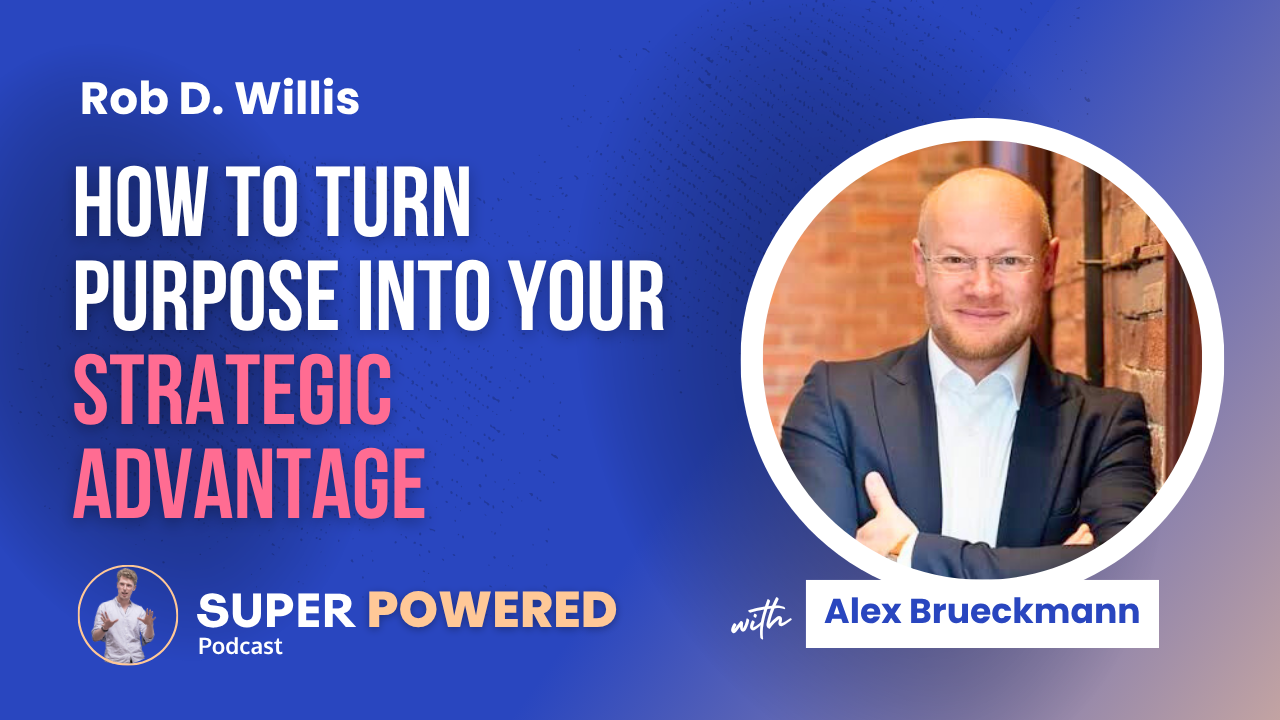
Ever wonder why some companies thrive with clear direction whilst others stumble despite having brilliant strategies?
Alex Brueckmann has cracked the code on turning organisational purpose into measurable strategic advantage through his Nine Elements of Organisational Identity framework.
As a Wall Street Journal bestselling author of "The Strategy Legacy" and strategy facilitator working with billion-dollar companies across continents, Alex helps C-suite executives move beyond generic mission statements to create authentic identity that drives every decision. His approach has guided organisations with thousands of employees through complete strategic transformations.
This isn't just theory from an ivory tower. Alex openly shares how leaders often get trapped in tactical thinking because it feels manageable, and reveals why even the most beautifully designed strategies fail when they hit the reality of company culture and leadership capability.
Key Talking Points:
- Why starting with tactics instead of identity leads to strategy confusion and planning paralysis
- The Nine Elements framework that every sustainably successful organisation needs in place
- How a billion-dollar global company with thousands of employees struggled to implement their "perfect" strategy
- Why resistance during strategy implementation often means people care deeply about something being threatened
- The critical question every leader must ask: "Am I an accidental leader or do I actually want to lead?"
Links & Resources:
- Alex's Website: brueckmann.ca
- LinkedIn: Alex Brueckmann
- Book: "The Strategy Legacy - How to Future Proof a Business and Leave your Mark"
- Book Recommendation: "The Power of Regret" by Dan Pink
- Recommended Reading: "Power and Prediction" on AI's impact on society
Today's Exercise: The Retirement Vision
This forward-looking exercise helps you make decisions today that align with your long-term purpose and desired life outcome. It transforms how you approach daily choices by connecting them to your ultimate vision.
Steps to Apply:
- Transport yourself mentally to your retirement age
- Visualise exactly where you want to be living physically
- Picture how you want to spend your days in detail
- Consider what kind of life would give you the most meaning
- Work backwards to identify what decisions today support that vision
- Begin making choices with that future life in mind
- Notice how this clarity brings more purpose to current decisions
Strategic Storyteller Newsletter:
Alex's insights on connecting purpose to measurable impact perfectly illustrate how the best leaders turn abstract concepts into concrete business advantages. For more frameworks on translating vision into tangible results, join my free 'Strategic Storyteller' newsletter at robdwillis.com/newsletter. Each week includes practical storytelling frameworks, personal insights, and curated resources from the podcast—all delivered in a 3-minute read.
Please note : This transcript is automatically generated and provided for your convenience.
[00:00:00]
[00:00:01] Alex Brueckmann: your strategy becomes your vehicle to turn your purpose, your intent into impact, something measurable, something tangible value that, that you create for your clients.
[00:00:16] Rob D. Willis: Welcome to superpowered with me, Rob d Willis. Each week I talk to leaders from inside and outside the business world about their superpowers, how they got them, and how you can get a bit of them as well.
If you're new here, please make sure to subscribe wherever you listen to podcasts. We've got some great people coming every week, and today I'm talking to Alex Brookman about turning purpose into strategic advantage in a world where. Many organizations, I feel struggle to move beyond generic mission statements.
Alex's book, the Strategy Legacy, has frameworks to help leaders use identity and purpose to actually drive decisions. It's the kind of like making purpose [00:01:00] your superpower. I can't wait to get into it. Alex, welcome to the show.
[00:01:04] Alex Brueckmann: Thank you very much for having me.
[00:01:06] Rob D. Willis: For anyone who's meeting you for the first time, could you just tell us a bit about who you are and what you do?
[00:01:11] Alex Brueckmann: I help. Executives, like C-Suite executives and their second line like SVPs, VPs to get their head around strategy design, strategy, implementation, and strategy facilitation is what I, what I often do and what I often help organizations with.
So I help them structure their quest come up with a winning strategy.
[00:01:34] Rob D. Willis: , Why should organizations begin with identity and purpose rather than the more tactical stuff, do you think?
[00:01:42] Alex Brueckmann: So let's define a few words. When I, when I use the term identity, it's, it, it's all encompassing, like. The framework that I created and that I describe in the strategy legacy is called the nine elements of organizational Identity. And those nine elements, [00:02:00] if you take a look at them, organizations need all of them.
You, you literally will not find a sustainably successful organization that does not have those things in place. Organizations often start with the more tactical part. It's just very natural. It's what feels the most tangible, it, what feels the most manageable. And when, especially in the context of strategy that leads to. confusion of what strategy is and what planning and budgeting is on the other hand. So if you don't put that framework of those nine elements in place, it is really, really difficult for many leaders to orient themselves. Where are they? What, what height are they flying on? It's this like, do I have my feet on the ground right now?
Is this very tactical? I flying helicopter or am I flying? Cruising Altitude of a Boeing seven. Seven, right. So it. What you do and how you think, and what mindset you need on those various layers or levels. [00:03:00] it's, it's what we know the best. That is the easiest for us and what we know the best if we are leaders in an organization our daily business, because that's what made us successful in the first place, that that's why we are here.
So. At some point you started in a certain subject matter and you become an expert in that subject matter, and then you maybe become a leader, which is a very natural transition for people that are really, really good subject matter experts. All of a sudden, they are the head of the sales department, for example, and then they become a sales director. But their, their subject matter expertise is what thrust them into leadership in the first place. It's not because they're great strategists. if you don't understand that framework that helps you orient, where are you right now? How should I think what other PA thought patterns and thinking patterns that are helpful? You always default where you came from, what made you successful. the problem with that is when it comes to leadership, your subject matter expertise becomes less and less important. The higher you grow as a leader and other people skills often become [00:04:00] more important. And if you, if you are able to help an organization grow into. True identity. subject matter expertise will only get used so far. And that's why you need to let go of those tactics and you need to embrace the longer term, the broader, the better understanding of how culture influences strategy, how strategy influences um, leadership, and how all these other elements that are. Within the strategy, the culture or your leadership need to come together to form identity. that is something that leaders very often in the daily business simply don't have the capacity for or the time for. They don't make the time to think on that, on those levels. And that's why I put those frameworks together and describe them so that leaders can get their head around it, like practically speaking, not from a theoretic perspective.[00:05:00]
[00:05:00] Rob D. Willis: Yeah. This is a challenge that I've heard a few times on this very podcast actually, and I imagine you've seen and worked with a variety of scales of company and I, I, it's kind of the stereotype, isn't it, that the startup has no real strategy or plan that just kind of going for it. At what stage do you feel.
It becomes absolutely vital to have a clear company identity in the way that you're describing.
[00:05:29] Alex Brueckmann: If you are a small startup, for example, and you are preparing for scale, there are a few things that you need to put in place, otherwise you don't even get the funding. So you really need to figure out what the value is that you create and then, turn that into a really, really good story that will convince. To support your business.
Once your organization grows, need to be very clear on what your culture looks like, because that's what, what. Defines us as human beings. It's [00:06:00] how we deal with each other, how we behave in a social setting. And work is a social setting. So understanding what drives you, what drives the organization, and how that connects to your personal values, for example, or to your personal in life.
And I don't wanna assume everyone knows what their purpose in life is, which is totally fine. And. Who you are as an ecosystem, as an organization, in the sense of what is valuable to you? What is based on those values, how do you behave in certain situation? How do you treat each other? How do you treat clients, suppliers, shareholders, all kinds of stakeholder groups. Like if you take a look at large organizations, for example, if they lose their sense of purpose, if they lose their, their cultural core. They fall apart, like literally fall apart. Those are organizations that then get entangled in massive scandals. You can go as far back as Enron if you want. You can [00:07:00] look into the most recent past, maybe not the whole organization, but parts of the Dieselgate scandal of Volkswagen is rooted in, in, in that loss of identity to a certain degree and certain behaviors that are definitely not in line with the organization's code of ethics and all these things. So the further you grow. And most of the clients that I work with are medium sized to large organizations. They need all those nine elements in place. They need to understand what their cultural core is, what they build their strategy on in the end, what their strategy is, how do they win in their market, and how do they need to enable their organization anchor strategy and culture, and hold it in place as long as it's still fragile in a certain way. always fragile in the moment of change, in the moment of transformation, that scaffolding that holds your culture and strategy in place is what we call the execution edge. So the skillset you need as leaders to really lead that change and that transformation. The ability to help [00:08:00] each individual contributor to see how their work contributes to the strategy and to the culture and how you measure performance. Ideally, individual's performance management is. Fully linked to strategy and culture and how do you adjust an organization's management systems, for example like how you make decisions, how you plan, how you allocate budgets, how you do the whole topic of governance. all needs to be in place so that you have a cohesive identity from culture to strategy to execution.
[00:08:36] Rob D. Willis: That's a wonderful breakdown and I wonder if you could also. Give us a bit of a definition of a word you've used a couple of times, which is purpose. How do you see purpose in this respect? Does it have to be saving the planet or bringing world peace, or can it be something which is a bit more focused on the business itself?
[00:08:57] Alex Brueckmann: the way we use [00:09:00] purpose as a term. Funnily enough, it's not even part of the nine elements framework. We use purpose as an intermediate step to come to what we call Impact. And the reason for that is there has been over the past decades, so much talk about purpose and so little action based on it.
And if you take a look at websites, you repurpose statements and like, yeah, that's just, what does it even mean? It's like just fluff and marketing claims and it's, you're like, that's just. And then there are a few really, really great examples of purpose and organizations that have embraced their purpose and are extremely successful also financially speaking because of their purpose and how their strategy links to it. So when we use the term purpose, we use it as an intermediate step to come to. Impact. And the way it works is for us, we asked a question like which problem in the world or in your target group if you want, in your clientele, are you uniquely positioned to address or even solve? It's [00:10:00] the question of what is your unfair competitive advantage?
Like, what are extremely good at that creates something of value and that re removes a problem. Your group has, or a certain, doesn't even have to be a target group at that stage. It's just what are you so good at that people would be willing to pay money for because you are solving a problem that they have that is the definition of purpose for us.
And, and then you basically strategy around that you to turn your unfair advantage. Into tangible value and tangible impact for your clients. And that's when you describe from what we are really uniquely positioned to solve is X. That's your purpose. Therefore, we make those choices here.
Like this is the handful of choices that we make, how we set up our business, how we run our operations how we create value in general. That's [00:11:00] strategy. And based on that, if we are successful in doing that, this will be the tangible, measurable impact for our clients. So your strategy becomes your vehicle to turn your purpose, your intent into impact, something measurable, something tangible value that, that you create for your clients. That's how we understand and how we define purpose.
[00:11:26] Rob D. Willis: I'd love if you could take us through. A mini case study of someone, a company that you worked with in the kind of scale of company that you do work with. So tell us about how big they were, what stage they were at, and what mistakes were they making at the moment that they started working with you.
[00:11:44] Alex Brueckmann: The, the trigger point those companies to start to engage us is often a new CEO or a change on the very top where someone new ideas, not necessarily about what to do, but how to do [00:12:00] it. if you bring in a new CEO, if you have a change in leadership, they have a unique opportunity to rewrite the script. how the organization functions, what they do, what they need to focus on, and very often change in executive leadership brings a new strategy. And why is that the case? Because. is a reason for change. There is a cost for change or a case for change. So an organization we have worked with relatively recently is a company that at, at the point when we started working with them, they made about as a global organization, and they have. On each continent. and they made about like close to a billion in revenue at that stage. Have a few thousand employees around the world, then a new CEO comes in. A relatively young CEO who has been in the industry for a while, who has kind of seen things are being done also has seen how kind of [00:13:00] the organization is in certain areas and they really see the potential in the business.
If the business focused more on what it's really, really good at and let go, all the distractions, all of the shiny objects and all of the things. Don't necessarily matter. So that CEO comes in and starts to work with a consulting company on their new business strategy. And they realize in the process that strategy piece, and it goes back to what you said in the very beginning, why do they start with a more tactical elements, right?
So in this case, with the strategy, without thinking about their culture first and. What will we actually eventually need to turn that strategy into something real? they work on that strategy piece and they realize have a relatively good understanding of who our clients are, which industry we wanna play in. and, and we, we think we know how we are gonna win. But then they realize at some point that this is only in, in the nine [00:14:00] elements framework. This is only the inner ring. There's only one of three rings. And they start to scramble and realize it's. Like we have not made that mental labor to connect our strategy to our culture.
We have not understood of what will our top 100 leaders around the world, what will they need from us? They like, it was a very collaborative process to create that strategy. But that is just one step. Of course, it needs to be collaborative to give people a sense of ownership in this whole thing, but then when it's done, when it's completed, and when you're like, okay, that's what we're gonna do now, people still need support because they have never, like in this particular business, something like that has never been done in the past decade.
So no one in the business has the experience of how do you turn a strategy, which is a theoretical construct. At that point, it's a designed strategy. How do you implement that strategy and what does that require from you as a [00:15:00] leader? How do you communicate to your people? How do you engage them in dialogues about strategy and how they can contribute help them understand and get answers to their questions that they might have? And, and all these elements around how do you turn something that is a beautifully designed strategy and in itself a cohesive story. How do you translate that and how do you implement that over the timeframe you've gave, that you, that you've given yourself that desired future state, which is a vision, right?
So a strategy helps you achieve a vision. And if you don't do that, if you don't prepare your people, if you don't help your leaders understand how their role looks like in implementing a strategy. It'll be extremely difficult for you to see any types of result anytime soon. And if you take a close look, it's often not the strategy as such that is the problem, but it's that a wonderfully designed strategy. Survive its first contact with reality, the [00:16:00] reality is your culture and your leadership, and those two things need to be closely tied to your strategy.
[00:16:06] Rob D. Willis: And chance, you know, wasn't it Tyson who said everyone has a plan till they get punched in the face? Like I'm wondering. Because the way you are describing it is, it makes perfect sense. But I don't imagine that when the company came to you, they were talking about it in that way. What were they saying was the problem when they came to you?
[00:16:28] Alex Brueckmann: Yeah.
[00:16:29] Rob D. Willis: I.
[00:16:30] Alex Brueckmann: They realized that they had extensive work on defining. Their strategy, but realized that they were kind of in their bubble, like totally pumped up with that strategy, and they realized that some point they will have to explain that strategy to other people. They will have to bring them on board and they will have to help them understand and have [00:17:00] conversations with their people.
Otherwise, strategy remains a cerebral exercise everyone in the business understands how their daily work needs to shift and change, and then they actually do that shift and change and take decisions in line with the new strategy. unless you have very simple things like how, how do you adjust? performance measurement and incentive structures to a new strategy unless you do all those things. And some of those things are just technical, how toss and others are, oh my God, I've never done this before. As a leader, how do I even do that? How do I run these conversations with my people? do I make sure don't shy away from asking questions back to executive leadership? If we feel we need more information or we don't understand certain things, like making strategy everyone's job every day, that is something that every organization at some point [00:18:00] realizes they might not exactly know how to do
[00:18:02] Rob D. Willis: Mm-hmm.
[00:18:03] Alex Brueckmann: not have enough experience with that. And that was when this company reached out, when they realized we have this strategy kind of thing. what do we do with that now?
[00:18:12] Rob D. Willis: What next? And how long is engagement with a company like that? Is this a a year long thing, or can you get them up and running in a couple of weeks? Or what, what's, what's the process?
[00:18:26] Alex Brueckmann: A regular engagement with us is typically between three and five months, I would say. But then there are also organizations that say, and we also want, we don't want you to only help us connect these elements.
We want you to facilitate the full process end to end. And that can mean between and nine months in terms of an engagement. Again, not every day on the ground, eight hours a day, but it's a, it's a process
[00:18:53] Rob D. Willis: story and the this is in a workshop setting generally.
[00:18:57] Alex Brueckmann: Some of these elements are workshop settings. Some [00:19:00] aren't
[00:19:00] Rob D. Willis: Oh, okay. So it, but it, it comes through conversation, through challenging, through talks, through contact, connection with each other. Then.
[00:19:09] Alex Brueckmann: exactly. We, we bring in the framework and the questions and the process we then help our organizations. Really get down into the mud and
[00:19:25] Rob D. Willis: Mm-hmm.
[00:19:25] Alex Brueckmann: it and get out on the other side and, and have a clear understanding of who they are how they're gonna win and how they're gonna make it work.
[00:19:36] Rob D. Willis: Do you ever find resistance to the process? And if so, what,
[00:19:40] Alex Brueckmann: yes, for sure.
[00:19:41] Rob D. Willis: what, what stage do you get the most challenges?
[00:19:45] Alex Brueckmann: We sometimes only get involved because there is resistance, because leadership realizes at one point, eh, it's not, it's not, we are just not gonna make this work. We need an external facilitator. We are too far apart, we can't find common ground. [00:20:00] And also one of the reasons they would then reach out.
And we would then, as I always say, as long as people are still vocal and as, as long as they're in active resistance, you can still work with them. They typically are in resistance because they care about something. So you need to uncover what it is that they care about and why they feel that whatever it is that needs to change a threat to what they care about. if you, if you can organizations and if you can help leadership teams uncover those things and become truly open about those things and start to rebuild trust that we are not doing. X to hurt person A. We're doing X be successful as a whole business. So if you can help people become stewards for the whole business rather than little kings and queens in their own little kingdoms and queendoms in an organization, you can have the right type of conversation that leads to. Positive conflict. [00:21:00] And if you can have and manage and lead and facilitate such types of conflict, you will come out on at the other end with something that everyone can get behind
[00:21:11] Rob D. Willis: Hmm.
[00:21:12] Alex Brueckmann: commit to. And with that comes. A starting point of a common journey and of common accountability and results focus. Someone who described this dynamic really, really well, and it's probably a book many of you out there have read, is what Patrick Lencioni wrote down when he wrote the Five Dysfunctions of a Team More than 20 years. It's that dynamic that you need to create in a leadership team that helps you. The right level of conversation to form whatever it is in the, in the sense of this podcast, whatever is your superpower, right? sometimes it's your culture. Sometimes it's the connection between the culture and the strategy.
And sometimes in an ideal world, it's the connection between your culture, your strategy, and the way you lead.
[00:21:59] Rob D. Willis: Let's go [00:22:00] to some rapid fires. Just a quick ideas for people. Have you got a favorite book apart from your own on purpose driven leadership and strategy?
[00:22:10] Alex Brueckmann: Well, I don't think my, my,
[00:22:11] Rob D. Willis: Okay.
[00:22:12] Alex Brueckmann: own books are some of my most
favorite books, , in first place. One
of my favorite books, lemme take a look, to the right, right now , I would say it's actually not in the, that you asked me about.
It's not purpose leadership or anything Um. . generative or general ai. Not in the sense of the, the hype, not in the sense of chat GBT and all these things, but more in the sense of how, , it will reshape society and the what is deeply meaningful for us human beings? And what is the purpose of being a human being? And if you think about that, I would, I would suggest reading books like power and Prediction. Like those books. Those types of books. They give me a a a really kind of this topic sometimes, but kind of also hopeful. About what the future of human beings can look like.
[00:22:57] Rob D. Willis: One daily habit that [00:23:00] keeps you connected to your purpose.
[00:23:02] Alex Brueckmann: Playing in the morning with my son. So almost every morning we have an hour together before he goes to daycare and before I start work where we just play together , this is the reason I moved to Canada, to give him an opportunity to grow up in a very open, very inclusive society. I'm not saying Germany is the opposite, but we have our struggles and, and generational trauma in, in, in Europe. We do not find here in Canada because the history is just simply very different of these countries, and that connects me deeply to my purpose.
[00:23:38] Rob D. Willis: One question every leader should ask themself about their organization's purpose.
[00:23:44] Alex Brueckmann: I would probably take two steps. I would ask myself as a leader, I an accidental leader? Am I a leader because I want to lead and if I am a leader because I want to lead, why do I wanna lead? That is the inherent question of
[00:23:57] Rob D. Willis: Hmm.
[00:23:57] Alex Brueckmann: leadership purpose. And with [00:24:00] that comes then the second step, that is the purpose of my own leadership, is the organization, I'm in the right one. Can I live up to my purpose and can I help shape this organization so that I can live up to my leadership purpose? And if not, you need to find a different organization. 'cause it'll always suffocate you.
[00:24:18] Rob D. Willis: Let's move on to the listener challenge, and in this part of the pod, we give listeners a exercise or a ritual, something they can try out to get a bit of your superpower. Alex, what have we got for us?
[00:24:30] Alex Brueckmann: My challenge to you would be teleport yourself into whatever it is, the age that you wanna retire, what do you see? How do you want your life to look like? Where is it physically? Where do you wanna retire? Is it the small village grew up in and still live in? Which is totally fine. is it some entirely different place on this planet? And how do you wanna spend your days? [00:25:00] And I promise you, if you have that in mind, you start making decisions in different ways already today, whether that's 20 years from now, 30 years or 40 years from now., This is not about financial planning for your retirement. That's part of it. Yes. But it's more about. What is the life that you wanna live? And, and the moment you do that, the moment you realize that you are working towards something your life today more meaning. 'cause each decision that you take, you take it with a smile in your face because, you know it'll help you to get to that point.
Eventually, and if you wanna read a book that is really, really good in that respect, it's Dan Ping's latest book. The Power of Regret, that's the title. that is really, really helpful.
[00:25:42] Rob D. Willis: You wouldn't believe it. That exact book was recommended earlier today in another recording of this podcast. Yeah.
[00:25:48] Alex Brueckmann: Well see. I mean, it's a, it's a brilliant book.
[00:25:51] Rob D. Willis: Alex, where can people go to find out more about you?
[00:25:54] Alex Brueckmann: If you dare to write my name, go to brickman.ca. And you find like all the free [00:26:00] resources that we provide to individuals, organizations around strategy, culture, and leadership. There are free courses. We also have a strategy certification program that we run for leaders who want to shape better organizational identity. Or you just read the tons of articles on my LinkedIn profile, you can also find me there. And yeah, reach out to me. I love having real conversations with real life people.
[00:26:21] Rob D. Willis: I'll be sure to link to all of that stuff in the show notes. Alex, thank you so much for coming on.
[00:26:25] Alex Brueckmann: It was a pleasure. Thank you for having me.
[00:27:00]
Subscribe to the Podcast!