
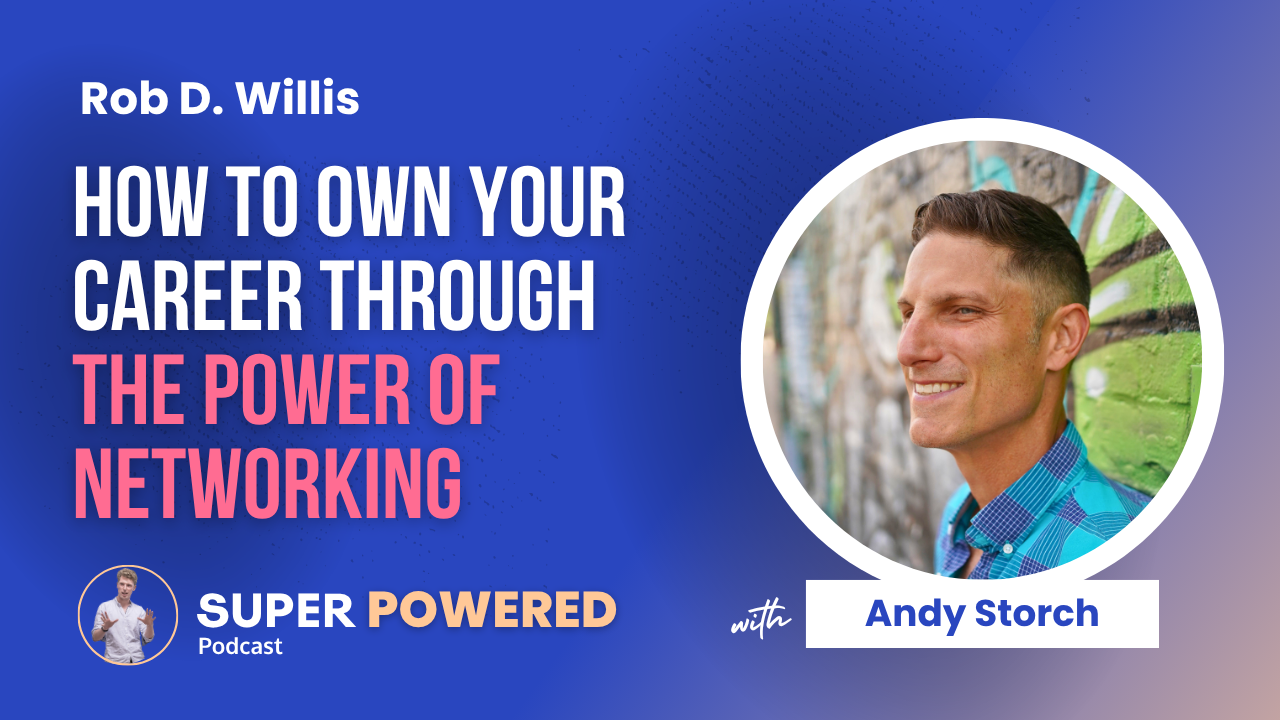
Ever felt stuck waiting for opportunities to find you?
Andy Storch transformed his approach by recognising that career success isn't about going it alone—it's about strategically building relationships that open doors. From his first job at 15 through to becoming an author, speaker, and founder of multiple successful ventures, every major opportunity came through his network.
Andy runs the Talent Development Think Tank community and hosts the Talent Development Hot Seat podcast with over 500 episodes and 500,000 downloads. He's moved from consulting at BTS to building his own speaking business whilst relocating from the US to Barcelona, proving you can design the career and life you want through intentional relationship building.
What makes Andy's approach refreshing is his honesty about the loneliness epidemic affecting modern professionals and why traditional networking feels so uncomfortable. He shares practical frameworks for building genuine relationships rather than just collecting business cards, plus the systems that help busy professionals maintain meaningful connections over time.
Key Talking Points:
- Why humans are social creatures by evolution but modern life has created an "epidemic of loneliness" despite being more connected than ever
- The counter-intuitive truth that "owning your career" doesn't mean doing everything on your own—every job Andy's had since age 15 came through connections
- How to escape the business card-throwing networking trap by building one genuine relationship at a time, whether virtually or in person
- The strategic approach to reconnecting with existing contacts and identifying new people to meet, including aspirational connections in your field
- Why giving value first (even simple restaurant recommendations) matters more than formal systems, and how to avoid the "LinkedIn pitch trap"
Links & Resources:
- Andy's Website: andystorch.com
- Book: Own Your Career Own Your Life
- Free Resources: andystorch.com/bonus
- Podcast: Talent Development Hot Seat
- LinkedIn: Andy Storch
- Book Recommendation: The Midnight Library by Matt Haig
- Community: Talent Development Think Tank
Today's Exercise: The Strategic Outreach Challenge
This two-part challenge helps you reconnect with existing contacts whilst building new strategic relationships. It removes the awkwardness by providing clear frameworks for both scenarios.
Steps to Apply:
- Reconnect with 3 existing contacts: Scroll through your phone contacts, stop randomly, and pick someone you haven't spoken to in 6+ months
- Send a simple message: "Hey [name], I was thinking about you and haven't talked in a while. Hope you're doing well!"
- Connect with 3 new people on LinkedIn: Search for your job title or aspirational role (e.g., "Director of Finance")
- Send personalised connection requests: "Hi [name], I see you work in [field]. I also work in [field] and I'm looking to connect with other professionals in our space to learn from them. Would you be interested in connecting and having a chat sometime?"
- Follow up within a week: If they accept, suggest a brief virtual coffee to get to know each other
Strategic Storyteller Newsletter:
Andy's insights on building authentic professional relationships remind us that the most powerful career tool isn't your CV—it's the genuine connections you cultivate over time. For more insights like strategic relationship building and authentic networking approaches, join my free 'Strategic Storyteller' newsletter at robdwillis.com/newsletter. Each week includes practical storytelling frameworks, personal insights, and curated resources from the podcast—all delivered in a 3-minute read.
Please note : This transcript is automatically generated and provided for your convenience.
[00:00:00]
[00:00:00] Andy Storch: We as humans are social creatures,
some of the best opportunities usually come through connections, through relationships, through who you know and who knows you,
Lean into building real relationships, right? Like truly trying to get to know somebody
[00:00:15] Rob D. Willis: Welcome to superpowered with me, Rob d Willis. Each week I talk to leaders from inside and outside the business world about their superpowers, how they got them, and how you can get them to, if you're new here.
Welcome. Please make sure to subscribe wherever you listen to podcasts. We've got great guests every week, and today I'm talking to Andy Storch about owning your career through the power of your network. And Andy is someone who really practices what he preaches. He's built a successful career by being intentional about his goals and leveraging his network.
He's gone from consulting at BTS to becoming an author, speaker, and host of multiple podcasts, including the talent development hot seat. He now helps others take ownership of their careers while [00:01:00] showing it's possible to design the life that you want, including his own move from the US to Barcelona recently.
Andy, welcome to the show.
[00:01:09] Andy Storch: Rob, thank you so much. I'm excited to be here.
[00:01:11] Rob D. Willis: For listeners who don't know you yet, could you just tell 'em a little bit about who you are and what you do?
[00:01:17] Andy Storch: Sure. Absolutely. So you mentioned some of it. I'm, I'm an author, a speaker. I primarily work with large organizations to help them improve retention and engagement by teaching and inspiring people to own their careers. I also do work around leadership development, mindset personal brand, things like that, primarily with large companies.
I also. I host a podcast you mentioned called the Talent Development Hot Seat, and I run a conference and a community for people in the talent development community. So
[00:01:44] Rob D. Willis: So that's
[00:01:44] Andy Storch: mainly what I
[00:01:45] Rob D. Willis: what I do.
[00:01:46] Andy Storch: work side. And then for my personal life, I'm also a husband, a father of two kids. And I like to think of myself as a, a cyclist.
I get out pretty regularly on the bike and also just someone who likes connecting and socializing and hanging out with lots of people.
[00:01:59] Rob D. Willis: [00:02:00] Why do you feel that the network is so crucial for owning your career?
[00:02:07] Andy Storch: Well, if you, if you really like back up. In history and think about, you know, human evolution. We as humans are social creatures, right? We have needed to be around other people to collaborate with other people really for survival for thousands of years. It's only been until the last probably hundred or even less that we can really get by without needing to be around too many other people.
But I think we still crave that and it's really hard to get. Far and achieve a lot completely on your own. So I talk a lot about the importance of owning your career and owning your life, but that doesn't mean doing everything on your own. I think it's important to get help where we need it. I think it's important to give help to others. I think many of us, whether you consider yourself an extrovert or an introvert tend to be more fulfilled when we're doing things with and for others. And so I think it's an important, it's important from a psychological standpoint and then [00:03:00] also. When we think about developing and growing in our careers, so many of the best opportunities I've found through my own career and just stories that I hear from others, that some of the best opportunities usually come through connections, through relationships, through who you know and who knows you, right?
So if I think back across my career, going back all the way. Back to when I got my first job when I was 15. That job came through a connection. My mother had the job after that, I got through a friend in high school. And then the next one was a through a friend in university and almost every job and business opportunity I've gotten in my, my life has usually come through some type of connection, some type of relationship.
So I just strongly think as you're on the road towards. Owning your career, building a career, and then thinking about how to set yourself up for future success. That networking is really a key element, something you need to be doing on a regular basis to not only try fulfillment and connect with other people, but to bring future opportunities as well.
[00:03:57] Rob D. Willis: Yeah, it really is something which is [00:04:00] universal, isn't it? 'cause as you say, your first job was got through someone in your network and I think. I am pretty confident everyone listening to this show had that early breakthrough because of someone in your network, someone who took a chance on you,
[00:04:14] Andy Storch: Right.
[00:04:14] Rob D. Willis: But networking just sounds a bit yucky, I find when you say the word. So what do you think is the misconception about networking that holds people back?
[00:04:23] Andy Storch: Well so two things there. We've gotten to a place in history for the first time where I. We didn't need to directly rely on connection to survive, right?
I always think we're, we're at a place for the first time in history where you could actually stay in your house by yourself and never leave and technically survive, right? You could work from home, order food through Uber Eats or you know, whatever delivery service and never see another human being in person.
And you could technically survive, but you'd probably be very unhappy. And that's why the Surgeon General in the United States famously. Released a report last year about the epidemic of loneliness, which has been echoed in many [00:05:00] other modern nations. That there is this epidemic where we're technically surrounded by people, but we're not really building those connections.
So a lot of communities have gone away. So I think we can all acknowledge that we, we need these connections. the problem is that they're, they're not as readily available. We're not as involved in local communities. We don't have you know, people are less involved in religious institutions maybe than they have been in the last millennium in our, our evolution. But there's still lots of opportunities out there through work, through other social gatherings, professional gatherings. The problem is, like you said, the term networking is intimidating to a lot of people, and I've found through my conversations with lots of people, I think. reason is when people hear networking, they picture walking into a room full of a hundred plus people, half of whom are real estate agents throwing business cards at you, right?
No, no shade or disrespect to real estate agents. I have many friends who are, but I used to go to a lot of networking events and there'd be a lot of. Real estate agents there. So what I try to remind people is that networking doesn't have to be walking [00:06:00] into a giant networking type event or a conference and meeting everybody there. It's really just about building relationships. Ideally strategic relationships with the types of people that you want to meet, but it's really about building relationships one person at a time. And that can be done in person, whether it's at a conference or an actual event or at the office. And it can certainly be done virtually as well. Just by reaching out to people and having one or two chats on Zoom each week and building those relationships, getting to know people, finding out if you have things in common, maybe mutual interests, mutual ambitions, ways that you can support each other, and then keeping in touch with those people, right.
You and I met through a, a couple mutual friends a few weeks back. We decided right away we had plenty of things in common. Now we're doing this podcast interview today, and I, and I suspect and hope that we'll keep in touch and continue to be friends even though we haven't actually met in person.
[00:06:51] Rob D. Willis: Yeah, no, totally. First of all, nice to meet you.
[00:06:55] Andy Storch: Great to connect with you, Rob.
[00:06:57] Rob D. Willis: But yeah, the, the first point you made about [00:07:00] doing everything on your own, people are talking about with ai, like there's gonna be a solo unicorn. At some point there's gonna be someone who scales a company to a billion with no other people. If you think about it.
[00:07:12] Andy Storch: Yep.
[00:07:13] Rob D. Willis: Sounds pretty rubbish to be honest.
[00:07:16] Andy Storch: Yeah. I mean, it may be. It may happen. How fulfilling will it be?
[00:07:19] Rob D. Willis: I mean,
[00:07:19] Andy Storch: know.
[00:07:20] Rob D. Willis: billion would be nice.
[00:07:21] Andy Storch: let me find out. I'll, I'll take it.
[00:07:22] Rob D. Willis: I'll take the billion.
[00:07:24] Andy Storch: Yeah. Yeah. There's a saying I love, I heard actually on another podcast by a friend of mine who said that everybody knows that money can't buy happiness, but they all wanna find out for themselves, right?
So give, give it a shot. But, but I think, you know, it might happen. I'd rather build something with other people or alongside other people and, and in some form of collaboration. But listen, things are changing all the time, right?
[00:07:46] Rob D. Willis: Yeah, but let's think about, you know, how you are, you're meeting people because you're right. The you mentioned that going to these events with business cards being thrust in your face, kind of not fun. I.
[00:07:58] Andy Storch: Yeah.
[00:07:58] Rob D. Willis: We're all getting [00:08:00] those messages on LinkedIn from people asking to just pick our brains for a few minutes.
[00:08:04] Andy Storch: Hmm.
[00:08:04] Rob D. Willis: And it again doesn't really feel great 'cause it's not novel anymore. And I think the problem with, with networking is when you're doing it in a space which is for networking, then it somehow feels less authentic. So I'm wondering how can you engineer building a network in a way that is intentional?
Because if you just wait for someone to come along by chance, it probably will happen at some point. But how can you be intentional about that? Where do you think people can look?
[00:08:34] Andy Storch: So I think the first thing is to a, start with the people that you already know and think about who, who do you want to keep in touch with, right? Because we all have, especially if in your, you're in your thirties, forties, fifties, like you've probably worked with several dozen, if not. Over a hundred people at this point that you could probably re reach back out to and keep in touch with.
And who of those do you want to keep in touch with and, and keep relationships with? Because you never know where that may go, whether it's just a friendship and someone that is [00:09:00] nice to chat with or someone who picks up a project one day and and can bring an opportunity to you 'cause you still work in a similar field. And then who else do you want to meet and get to know? And you can start to get strategic and thoughtful. those types of people. So if you work in hr, connecting with other HR professionals, if you work in finance, connecting with other finance professionals just to learn what are they working on, what types of things are they learning, are they striving to do what are some of the challenges they're facing? And just getting to know other people in your field can be kind of helpful. If you're running a business, you're an entrepreneur, we, we always love connecting with other entrepreneurs to find out, Hey, what are they doing? I think when you and I chatted it, we were kind of like, Hey, what do you, what kind of work are you doing?
How do you, you know, how do you typically operate? What, how do you get clients? Just sort of chatting with each other and seeing what we can learn from each other and other things that we want to continue to talk about in the future. if you're meeting enough people, you're going to have some quote unquote connectors in your network who will probably be willing and, what's the [00:10:00] word I'm looking for? Who, who will be bringing more introductions or connections your way? As I mentioned, you and I met because we have a couple mutual friends one of which who's a, a big connector, Bob Gentle. And so we're more likely to then connect with other people because of that.
So I think we could be strategic and we can also open ourselves up to. Who are the types of people that are, you know, we can open ourselves up to other people kind of popping up into our network and being willing to ask questions and get to know them.
[00:10:28] Rob D. Willis: Mm-hmm.
[00:10:28] Andy Storch: is, one other thing I was thinking as you're asking a question is to. Lean into building real relationships, right? Like truly trying to get to know somebody versus just collecting names and building a quote unquote network. There's a guy on LinkedIn that I was introduced to and he sort of like has this reputation as this big time networker, but what I've found, he doesn't actually truly take much time to get to know people. He just collects a lot of names and then makes a lot of introductions. So I got on a Zoom call with him for like five minutes. He was like, what do you do? [00:11:00] Okay, I have a few people you should talk to. And then made like 10 introductions on LinkedIn. Most of them were not relevant to what I needed in my business,
[00:11:08] Rob D. Willis: Mm.
[00:11:09] Andy Storch: I found the whole thing to be pretty much a waste of time.
And then since then, I. I keep getting introduced to this guy on LinkedIn because he is doing the same thing across the board, you know, dozens of times a day or a week. And I just wonder like, what's the point? Like maybe something will come for him,
[00:11:26] Rob D. Willis: Mm-hmm.
[00:11:26] Andy Storch: to truly be adding value to others because he is not really taking the time to get to know people or build a meaningful relationship.
And I would rather, even though I'm known for having a pretty. A good network or a big network. I'd rather have a, a smaller group of meaningful relationships than just know a million people, but know nothing about them. And there's maybe some middle ground for that as well, based on your own personality.
But it's really about truly getting to know people and then having them get to know you and what you're trying to accomplish, whether they can make some connections and introductions for you in the future.
[00:11:58] Rob D. Willis: Can we just talk about like [00:12:00] how you've built up your networking habits? Because when you're intentional, that implies that there is some sort of like goal associated with it,
[00:12:08] Andy Storch: Hmm.
[00:12:09] Rob D. Willis: want to achieve something with it.
Could you tell us about, I don't have to name names, but a relationship that you were able to engineer and kind of what that, what that can bring? For you and has brought you in your own development of your business.
[00:12:24] Andy Storch: So I, if people are just getting started with this like when I do sessions in organizations or I think I, me mentioned in my book, I do recommend setting a goal if it's something new to maybe reach out to one or two new people a week so
[00:12:38] Rob D. Willis: Mm-hmm.
[00:12:38] Andy Storch: a network. I personally don't work. With any type of goals because it's, it's become such a natural kind of habit for me to be building relationships and having conversations every week. And I'll say this, you know, the context is that I do run my own business. I kind of make my own schedule. Like you, but also like you, I, I'm kind of on my own.
I'm a solo entrepreneur, therefore. [00:13:00] have to be reaching out and talking to people mostly online on Zoom. But intentionally having these conversations so that I am still building relationships, collaborating with other people and not just sitting here, you know, working on my own all day long because that, I don't find that to be as fulfilling and I think anybody. Even, especially if you work in a larger organization but you're remote and you're not necessarily seeing people on a regular basis can still be doing this by being proactive and reaching out and saying, Hey, I'm gonna reach out to two people a week or three people a week and just ask if we can get on a 15, 20, 30 minute zoom. Virtual coffee, if you will, and just ask people questions. Get to know them, find out what they're working on, what they do. Are there ways that we can collaborate or things that we can learn from each other? And so I am.
[00:13:49] Rob D. Willis: I.
[00:13:49] Andy Storch: You know of, like you and I are running a business, so I'm always reaching out, looking for potential clients, but also potential partners and collaborators, just trying to learn about people and find out about people. You asked for [00:14:00] an example of a relationship that was sort of strategically built. one that came to mind was, I was connected many years ago by my friend Lauren Davis with a friend of hers named Mike Kim. And Mike became a mentor and someone that I followed and I kinda strategically worked on building a relationship with him. I think we developed a mutual admiration and now we're working on a book together. And that came about because, you know, we were first introduced and then kind of ended up in each other's orbits, had each other on each other's podcasts you know, built that relationship over time. I joined his mastermind group and followed on and, and implemented a lot of things that I learned from him. And like I said, he is, he's become a mentor and a friend. And now we're, we're working on a book together. And there's lots of. You know, relationships I have like that, that have kind of been built over time and you just never know where it's gonna go when you first start. But you can recognize when you see people and you're like, I wanna spend more time around that person.
I wanna learn from that person and
[00:14:57] Rob D. Willis: Mm-hmm.
[00:14:58] Andy Storch: where it goes.
[00:14:59] Rob D. Willis: What I [00:15:00] find is quite hard sometimes is you can meet someone and really hit it off,
[00:15:03] Andy Storch: Yeah.
[00:15:03] Rob D. Willis: then, you know, you get busy and then you go into something else and you meet someone else and. The follow it's the follow up with someone who's not in your general circle that often,
[00:15:13] Andy Storch: Right.
[00:15:14] Rob D. Willis: really hard.
Have you got a system where you to, to maintain that?
[00:15:17] Andy Storch: So I agree. And even though I'm someone who, you know, I wrote a couple chapters in my book about networking. We're talking about networking. I get interviewed about it. Like I probably have a huge wake of people behind me, for lack of a better term, right, that I've met. And we said like, oh, this is cool. We should talk more. And then neither of us followed up and didn't necessarily go anywhere. The one thing I I will say is while social media gets a bra bad rap, right, for a lot of things, I do like having social media as a tool to be able to keep up with a lot of people, especially LinkedIn, but other platforms as well, like Instagram and Facebook. and then I will try to. You know, periodically reach out and keep up with different people that I've met at different times and, and developed relationships with [00:16:00] over, whether it's text or, or anything else. I don't have a formal system. I've thought about that a lot over the years. I know some people that do.
I had a mentor and coach at one point who she had a full spreadsheet of, like everybody that she's ever met and talked to and had like a 90 day, you know, sort of like quarterly outreach strategy. I think if you're really organized, you can do that. There's a risk that it becomes, I feel like a little bit too kind of robotic.
Right? Versus just anytime you read an article, something I try to stick with. Like I read an article, a book, I listen to a podcast, I see a video, and I think it's relevant to someone on my network. I'll probably send it to them and say, Hey Rob, I just listened to this. I thought it could be helpful for you. How's it going? That might start a conversation, or at the very least. You feel like I'm, I'm thinking of you and sending you something of value, and I appreciate when people do that for me as well. So another thing that I may try to do is just randomly go through my phone and pick out a couple people from time to time and just send them a note and say hi and see how they're doing. I love LinkedIn too because I'm on [00:17:00] LinkedIn scrolling all day, and I might see posts from people or messages from people or something I haven't talked to a long time. And then. We can spark and, and start up a new conversation from there. So I don't have a, like a formal system around it. I do have a CRM where, you know, a customer relationship management software where I track a lot of my client relationships and I'm, I'm still trying to get better at this, but I know others are better at systemizing it.
Do you do anything like that?
[00:17:23] Rob D. Willis: So I've got a relationship manager called Dex, DEX, which is quite good. It, it syncs up with everything because like I said, I'm just terrible at re, re, re remembering to reach out because my days sort of wake up. There's insanity at home. As I try and get my daughter to get ready for school or, or kindergarten, then I come.
Work, then I go back and then there's insanity again, and then you're just kind of too tired to think about anything. So having some sort of system really I find very helpful. But you've just given me a great idea, which is to keep [00:18:00] that, but also think about triggers in your own life. So I think things you read, movies, you watch an album, you discover a place you go to.
Kind of surfaces ideas or people in your network that would be relevant and would enjoy that thing.
[00:18:19] Andy Storch: Right.
[00:18:20] Rob D. Willis: if you get in the practice of like every time you read a book, ask yourself the question who, what three people would like this and why would they like it? And then send them a message. No, not expecting or reply or anything that could be really powerful.
[00:18:33] Andy Storch: Them to read the book, you don't have to have expectations. Right? That they'll actually read the book or get back to you, or you start a book club, whatever. It's just showing that you're thinking of them and it's, it's providing them value. 'cause you never know. They might be sitting there thinking, what book am I gonna read next?
And then you pop up.
[00:18:47] Rob D. Willis: Yeah. And it, it is just a nice thing to do, to have, feel that someone has thought of you in a particular moment. 'cause I've tried, I, I do have occasionally a little reminder pops up in the system and [00:19:00] I'm like, God, what on earth am I gonna write to them about?
[00:19:02] Andy Storch: Right.
[00:19:03] Rob D. Willis: It's been six weeks since I last wrote to you.
So
[00:19:06] Andy Storch: Yeah.
[00:19:07] Rob D. Willis: are things.
[00:19:07] Andy Storch: I tried Dex and I, I couldn't make it work for me, but I love the intention of it, and I think there's. A ton of potential and value there and, and certainly worth trying. And I think the, the gist of it, right, is that you, you pretty much load all your contacts in there
[00:19:21] Rob D. Willis: Yeah.
[00:19:21] Andy Storch: gonna give you regular reminders, nudges, like you said, every six weeks or quarterly or every six months or whatever, that like, Hey, you haven't talked to this person in a while.
You should,
[00:19:30] Rob D. Willis: Yeah.
[00:19:30] Andy Storch: out.
[00:19:31] Rob D. Willis: And also reminders. And you can see when you last spoke and you can keep notes on what you said last time and so on. That stuff really helps. Like remembering that people have children, what their children's names are, what's going on in their life. 'cause it, it requires a super human effort to remember all of that.
[00:19:49] Andy Storch: yeah, I
[00:19:49] Rob D. Willis: My mind can't do it. Is your CRM more kind of pipeline to get people from one side to another, or is it also sort of relationship manager?
[00:19:58] Andy Storch: Well, I mean, [00:20:00] historically I've at least used it to track all of my contacts. I've used HubSpot a lot for that. And then over the last couple years I've transitioned a lot of my business managing everything in there to Notion. And so now in notion I have tracking of course, but I also have most of my. Keep in touch type connections on the professional side that are potential clients and like when was the last time I reached out to them or, or talked to them? And it's a good reminder to be able to reach out and, and have conversations, but I haven't used it on the personal side.
One interesting thing that I've noticed you mentioned at the beginning in the introduction that I moved. From the United States to Spain and I, you have also made a big move in the past, moving from the UK to Germany, is that even though easier than ever and it shouldn't be, it shouldn't make a difference because most people I connect, I keep in touch with are. You know, virtual through text message or calls or whatever is that I haven't been talking as much with a lot of my friends from back in the US as I used to when I [00:21:00] was there, even though we didn't live in the same city. And I spend more time talking to and connecting with friends that I've made here in Europe and especially in, in Barcelona where I live. And I just wonder there's there gonna be some like, you know, psychological phenomenon behind that where like, I find people don't even reach out to me as much. Maybe 'cause they think like, oh, he's moved to another
[00:21:21] Rob D. Willis: Mm-hmm.
[00:21:22] Andy Storch: He's harder to reach. I mean, time
[00:21:24] Rob D. Willis: Yeah.
[00:21:24] Andy Storch: a, is a big factor too. I'm six to nine hours ahead of a lot of my network now, which definitely makes it more tricky.
[00:21:31] Rob D. Willis: Now I agree. And now you're talking, you're making me think about sort pattern recognition.
[00:21:37] Andy Storch: Yeah.
[00:21:37] Rob D. Willis: when you move to certain area, certain locations, there'll be things that happen more or less depending on which part of the network you're talking about.
[00:21:46] Andy Storch: Yeah.
[00:21:46] Rob D. Willis: But I'd also love to continue that and think about, look back on the network that you've built up.
How you've got that and which bits of it have been most worthwhile? [00:22:00] Which networking activities do you find to be the most worthwhile, and which things do you think in hindsight, actually, I could have probably missed that and would've been fine.
[00:22:08] Andy Storch: Hmm. interesting. I mean, I think it's, it's always a mix. You never know where things are gonna go. In terms of networking opportunities, I have attended lots of conferences. I've joined lots of online communities and mastermind groups. I. I went back to school 20 years ago and got an MBA and one of the biggest reasons for that was the school I went to was known for having a strong network it paid off with lots of friends, but I do think sometimes I didn't end up working in a space I. Where I needed an MBA terribly. And so I do wonder if that was you know, I hate to discount any of the friendships I made there, but I did pay like $90,000 short. So that was probably one where I don't know entirely if it was worth it, but it was definitely a great experience. I made some good connections.
It got, ended up getting a couple jobs and made a lot of great friends from it. [00:23:00] Most of the conferences I've gone to, I've at least met a couple interesting people that have become friends. The one I mentioned in London that I went to where I met that woman, Lauren, is also where I met Bob, who introduced us.
That conference doesn't run anymore, but it was it attracted some really great people and I made a lot of great friends from it. I found joining. I. like I'll say paid online communities, if you will. So the free ones tend to like, it's, you gotta like sort through a lot of stuff, but when you're paying to belong to an online community and people really want to be there and it's over some type of mutual interest, like entrepreneurship or development, I run a community on talent development.
But it could be some other type of writing or whatever. I used to be, it started out for me, actually, I belonged to one for fathers. I made so many great friends through that. So I've made a lot of great friends through those communities where people are like there intentionally to connect and learn. So I've found that to be really valuable. And then, you know, I've mentioned LinkedIn. I'm on there every day as I know you are as well. I. Intentionally reaching out and connecting with people [00:24:00] that I want to connect with who are working in the same kind of space as me. And I found that's paid off not only for me to find clients for my business and partners and collaborators, but I, I've made a lot of friends on there as well.
People I just keep in touch with that I enjoy hanging around. So that's been a great platform for me that I think is worth the investment, whether you have the free or the premium version.
[00:24:19] Rob D. Willis: If you are teaching people, and I know that you help people with networking and so on, how do you help them sort through what will be the best area for them and if say like they want to get going with LinkedIn and actually networking on LinkedIn,
[00:24:33] Andy Storch: Yeah.
[00:24:33] Rob D. Willis: do you recommend they start going on, going about doing that?
[00:24:37] Andy Storch: I think the, so the best way to start is a start by going back to people that you have met and you've worked with, and that you already know and add them to your network. I see no downside to that whatsoever. When it comes to LinkedIn you know, something like Facebook, there's always a risk that you're gonna connect with somebody and then you're gonna, they're gonna be, you're gonna see them posting like. Crazy political stances that you don't [00:25:00] agree with, right? But with LinkedIn, that risk is very low. There's only upside because now you have them in your network. You can keep in touch, see what they're doing for a job, when they change jobs, what type of work they're doing, and then you can start getting strategic and think, what types of people do I want to connect with?
Again, if you work in finance, maybe you're a financial analyst and you wanna become a manager or a director one day, can you start connecting with some directors of finance? a message like, Hey Rob, I see you're a director of finance at x, Y, Z company. I'm a financial analyst right now, but I aspire to be a director one day and I wonder if we can connect and I can just chat with you to find out what you're working on and, and learn from you if you have anything in common.
Especially if they happen to have gone to the same university or at belong to some trade association that you belong to, whatever. There's a good chance they'll accept and be willing to have a conversation with you. And that's the aspirational. Connection, but you can also be connecting with your peers, people who are doing similar work as you, connecting with other people inside your organization.
If you work for a large organization to learn as much about what people are doing and [00:26:00] just start to build those relationships. And remember, like not everybody's gonna connect. Not everybody's gonna respond. That's okay. It's not usually personal, everybody's busy. But it's about being proactive and reaching out and being thoughtful about who are the types of people that you want to connect with so that you can start those conversations because you never know where they might lead.
[00:26:19] Rob D. Willis: Yeah, it's. Get started, reach out. Know that it won't always work, but as long as you find some sort of causality for reaching out, like we have something in common, or
[00:26:31] Andy Storch: Yeah.
[00:26:32] Rob D. Willis: you're doing something particular that I like, not just that I wanna sell to you, but like this particular specific thing, you get a much, much higher chance.
It's like in even people who do sales outreach, they're looking for triggers. This is a reason that I'm. Reaching out to you right now, that increases your chances. Now you can't shortcut actually turning them into a valuable networking member. You've gotta.
[00:26:55] Andy Storch: give them a reason and don't put them in an awkward position. You're not asking for something that is, is [00:27:00] hard for them. You're not asking for a job or a sale right away. You're asking to build a relationship. Can I just get some time to learn about what you're working on? And a lot of people are, are pretty open and amenable to that.
[00:27:11] Rob D. Willis: Let's move to some rapid fires. I just need some quick little tips for everyone here.
Most underrated way to add value to a professional relationship.
[00:27:20] Andy Storch: I think the most underrated way to add value, I. It is just to give suggestions in little ways that don't have to be big or even really professional related. So I say it's underrated because I think we think adding value is like finding somebody a job or you know, a business contact. But like you can make a dinner, a restaurant recommendation or a movie recommendation to somebody. And they'll appreciate it. My friend recommended a movie to me last Friday and my wife and I watched it over the weekend and we really enjoyed it, and I thought of him and I thanked him and that added value to my life. And that's it.
[00:27:54] Rob D. Willis: One networking mistake you see people make.
[00:27:57] Andy Storch: I think one of the most important tenets of [00:28:00] building great relationships is giving before taking or giving before asking for anything if you can. And a lot of people just start by asking for something right away, or seemingly asking for something. That's where so many people, you know, LinkedIn gets a bad name, sometimes a bad rap because so many people are connect with you and just pitch you on something instead of.
Maybe trying to build a relationship first. So I think the wrong way about it to go about it is just asking people for something or expecting that they're gonna do business with you without any kind of relationship whatsoever. So maybe it's just moving too fast or trying to take before you give.
[00:28:34] Rob D. Willis: Have you got a. Non-business book. So any kind of story really. It could be a biography or it could be fiction. Something that has inspired you.
[00:28:47] Andy Storch: There have been so many over the years, but a novel that I have recommended to many people that was really powerful for me was a book called The Midnight Library by Matt Hague.
[00:28:56] Rob D. Willis: I love that book. That's really, really beautiful.
[00:29:00] Let's move to the listener challenge, and in this part of the pod, we give listeners an exercise or a ritual, something that they can try out over the next week to get a bit of your superpower. Andy, what have you got for us? So
[00:29:12] Andy Storch: So this one's
[00:29:12] Rob D. Willis: this.
[00:29:13] Andy Storch: It's two parts. It's reaching out to people that you already know, and it's finding a couple new connections as well. So for the people you already know, the easy thing to do here is to take, grab your phone and just go to contacts and scroll through. I sometimes will do this.
I'll just scroll, hit, like scroll really fast and just stop it somewhere. And pick somebody to reach out to, ideally, that you haven't talked to in more than six months or maybe a year. And just send 'em a text message or even give 'em a call if you wanna be really bold and check in. Just say, Hey, I was thinking about you haven't talked in a while.
See how you're doing. Do that for three people. Maybe even send 'em a voice note and then for new people go to LinkedIn. type in the search bar of any type of field or type of person you might want to connect with. Financial analyst, director [00:30:00] of hr VP of it, and just pick three people on there and send them a connection request with a custom message that says. Hey Rob, I see you that you work in it. I also work in it. I'm just looking to connect with other people in our space to learn from them. Wondering if you'd be interested in connecting and, and having a chat. Sometime, that's it. They may not all connect, but hopefully one will and it will lead to a conversation and maybe a new relationship.
[00:30:24] Rob D. Willis: Fantastic stuff, Annie. Where can people go to find out more about you?
[00:30:28] Andy Storch: Well, my book is called Own Your Career. Own Your Life If you Don't Want to. It's available on Amazon in every country if you don't wanna buy or read a book. I also have free resources on my website, including the five steps to Owning Your Career, as well as my morning routine and some other bonus resources.
You can go to andy storch.com/bonus. That's andy storch.com/bonus. And I also. Have a couple podcasts, including the Talent Development Hot Seat, and the Own Your Career show.
[00:30:56] Rob D. Willis: Awesome. We'll link to all of that in the show notes. Andy, thank you so [00:31:00] much for coming on.
[00:31:00] Andy Storch: Thank you, Rob. I really appreciate it. This was awesome.
[00:32:00]
Subscribe to the Podcast!


