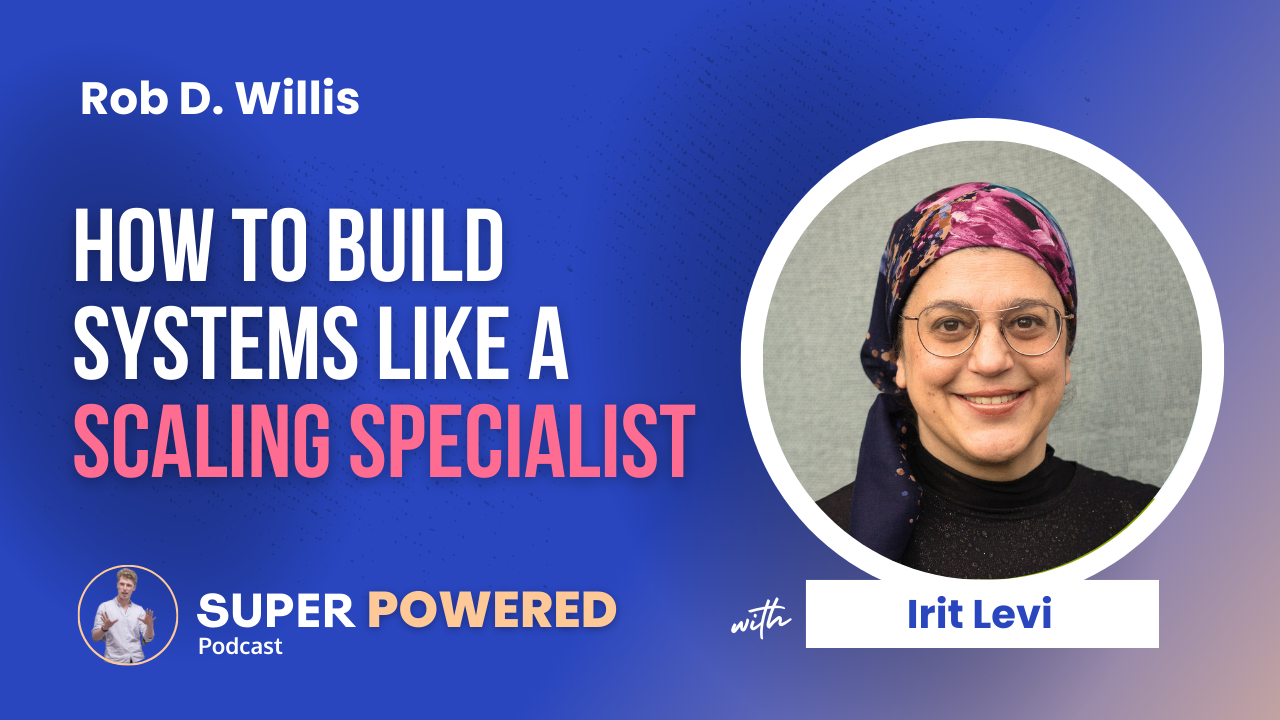
Ever wondered how top companies handle 10x their workload without breaking a sweat?
Irit Levi spots the systems gaps others miss - whether that's identifying redundant tasks that waste team hours or finding ways to make your customer journey seamless. She's the expert behind 13,697+ software recommendations that have transformed business workflows.
From her early days as an instructional designer for high-tech companies to becoming a systems consultant who's tested 978+ tools, Irit has mastered the art of turning chaos into scalable processes. Having grown up across four continents, she developed a unique ability to quickly understand different environments and adapt systems accordingly.
Despite her technical expertise, Irit reveals that systems often fail not because of technology but because of people. She shares the communication strategies that transform resistance into buy-in and how leaders can implement systems that teams actually want to use.
Key Talking Points:
- Why successful systems must support your weak points - especially follow-up tasks where "we all drop the ball every so often"
- The counter-intuitive truth about control: systems don't remove control, they give you more of it
- How to identify when your team needs better systems (duplicate code, customer journey inconsistencies, unclear responsibilities)
- The role of fear in systems adoption and why getting early buy-in from team influencers is crucial
Links & Resources:
- LinkedIn: Irit Levi
- Website: day-by-day.biz
- Tool Recommendation: Airtable for team collaboration
- Podcast: Off Tangent, co-hosted with Zineb Layachi
Today's Exercise: Process Mapping
This exercise helps you identify opportunities for automation in your most critical workflows. By thoroughly documenting each step, you'll spot repetitive tasks that can be delegated to tools.
Steps to Apply:
- Choose one critical process in your business (like sales or onboarding)
- Write out every single step in extreme detail, including decision points
- Note who is responsible for each task and approximate time required
- Identify all qualification criteria, templates, and communication points
- Review the completed map and circle repetitive admin tasks
- Research tools that could automate these specific tasks
- Implement one automation to test the impact on your workflow
Please note : This transcript is automatically generated and provided for your convenience.
[00:00:00]
Irit Levi: so systems help us manage our workload as a company.
They help us manage our resources to make sure everyone's working on the right thing at the right time without duplications and they help our communications and that affects our customer journey,
Rob D. Willis: welcome to Superpowered, the show where we talk to experts who've mastered their skills in the most demanding situations. They share what actually works, so you don't have to learn everything the hard way. My name is Rob D. Willis and this week I'm talking to Irrit Levy about systems and scalability.
Irrit builds systems and automations for businesses, helping them scale and work more efficiently. I think though that all of us can benefit from understanding more about systems. Systems drive how our businesses and indeed the world works. So when you recognize them, it can help you make decisions, minimize errors, and generally get through life with a lot less stress.
In this episode, Erit is going to give us some [00:01:00] strategies for recognizing whether you need a process or not, how to implement it, and how to make sure that your team actually follows through. If you haven't done so already, please make sure to subscribe wherever you listen to podcasts, and get ready for this interview with Erit Levy.
Hey, Erit, welcome to the show. Great to have
you here.
Irit Levi: Thank you so much for having me. I'm so excited.
Rob D. Willis: I've been excited for this too. I've been reading your content for a long time, particularly love all of your stuff on automation and systems. And I read that you've actually provided recommendations for 13, 697 people. plus pieces of software. I imagine there's also a system behind that. But for people who don't know you, could you just tell us a little bit about yourself and how you help people?
Irit Levi: So my name is Rit Levy and I help companies scale by optimizing their workflows and their systems. And [00:02:00] then we see what we can delegate to people, what we can delegate to tools and how we can make it so that they can grow while focusing on their zone of genius, rather than focusing on admin and stuff that they don't want to be doing.
Rob D. Willis: Such a valuable thing to be doing. And I'd like to jump in straight with the kind of high level look at scalability. So, I don't know how you look at it as pillars or areas, but what are the essential elements for a system to actually make sure that it is scalable in your mind?
Irit Levi: Well, It's really hard to define a generic what makes a system scalable because every system is going to be different. The idea is you should be able to handle double, triple, ten times the workflow, the workload that you have at the moment without breaking a sweat, without things falling between the cracks.
So in order for a system to be scalable, it needs to be able to support you and all of the things where you're weakest [00:03:00] and all the things where there's, there's A slight chance, not to mention a large chance that things are going to fall between the cracks. So if it's follow up emails, because we all suck at those, I'm sorry.
There's no one who is doing this like by hand and is not dropping the ball every so often follow up emails, sending out documents or creating documents and folders and onboarding clients with all the admin stuff in the background. Like all of that. You have to get it off of your plate, off of anybody's plate.
It should be as, as automated as possible so that you don't have to worry about that. You just press a button, go client one, check, everything else happens, and then you can start actually working with the client. Now, this is true. There's always going to be a human interaction element in any process, but even in sales, I had a client once who was doing Physical tangible sales, but we had to like [00:04:00] automate the system so that she could focus on creating and and sending them out and giving the client the support that she needed without hiring 10 other different people to make sure that every order was proper and and done correctly.
So that's the idea. You want to be able to do it so that you're still going to be doing work. It's systems are not going to replace us. AI is not going to replace us. But the idea is to use the tools to make your life so much easier.
Rob D. Willis: Yeah, I quite agree. I heard something recently about the AI revolution and comparing it to the industrial revolution. Essentially what the industrial revolution made redundant was human strength. And now what AI is making redundant is mundane intelligence. So it is, I guess that's what we're automating is the mundane intelligence just going through the motions.
Yeah.
Irit Levi: Yeah,
absolutely. And there's so much of it in every business, right? [00:05:00] Online or offline. There's so, there's so many mundane tasks that we're doing. I mean, Let's think of a hairdresser making this up on the spot, okay? But let's go, a woman goes to a hairdresser and she goes to the same hairdresser every time.
When my mother used to go, when we were like kids and before, they would have like a Rolodex and they would pull out your card and on it, it would say, okay, this is what she likes to drink. This is the color that we did for her hair last time, right? I want to be able to not have to pull out that Rolodex card.
And it's so easy because you, you Ask the client, for example, for their preferences when they come in for their beverage. And that's it. You have it forever. When they come up, when the appointment is scheduled, it already pop ups on your window. You don't have to go looking for it. The appointment was scheduled.
It's already connected. Now that's a really silly example, but it's there, right? And if it, It means that any business today can find what are those things that make my client [00:06:00] journey better, that make my life easier, that I don't want to be doing.
Rob D. Willis: that makes total sense, and I like that you put it in this very simple example of a hairdresser. Let's go center in slightly more on an example which may be very true of the listeners of this show, which are mostly leaders of teams. Let's say there's someone who's leading a technical team out there, and they've got Okay.
20 30 people in their team. What do you think are some of the red flags that they will be seeing which indicates that their systems are not up to
scratch?
Irit Levi: Great question. So in my mind, a technical team, maybe someone with programming, for example. And if I have duplicate pieces of code that different different coders have written, right? Something is wrong with my system. Because if I have a piece of code that does X and I [00:07:00] need it in different elements in my program, that piece of code should be accessible.
I mean, GitHub does that and a lot of other tools, but like, if your team doesn't know that somebody else wrote it and they're rewriting it, A, you're wasting valuable time and resources because the same piece of code is written by two different people. B, it's not going to be identical, so this is going to affect your customer journey because I'm going to experience this element once.
One way. And the second time, it's not going to be exactly identical. And I have tools that I use, I can tell you, it was the same piece of code written by two different people. I know that from my experience using the tool. So you're wasting resources. The second is your customer support. Because, again, if I have one central location where I can see the epic, the story, the sprint, whatever methodology you're using to develop your tools, As a customer support person, I need to know who the point person for every element is.
[00:08:00] And if I have different people, again, writing the same piece of code, or there's a mess, I don't know who's doing what. Especially in startups, you're going to see that. Because one person does, you know, they wear many hats. They wear ten different hats. Because it's a startup and they don't have money to hire enough people.
So it causes confusion within the system of who's doing what. Also, things are going to fall between the cracks. My deliverables. If I have a deadline and I don't know who's working on what and when it's due. And I've had, I work with companies where employees have a real issue putting in due dates. And that's going to cause a problem for the higher ups.
And if there's no communication between the teams, Then they don't understand the value of putting in the due dates. And then the higher ups are now, I don't know what the workload is. I don't know what we can take on more, how, how much more we can commit to what are realistic deadlines. So systems help us manage our workload as a company.
They help us manage [00:09:00] our resources to make sure everyone's working on the right thing at the right time without duplications and they help our communications and that affects our customer journey, which for me is like the most important thing.
Rob D. Willis: Yeah, a business essentially is a customer journey
at the end of the day. thing which really resonated there with me is your point about people don't know who's doing what, who's responsible for what. In a scaling company, that almost always happens in my experience. It scaled too quickly, they had an idea, something was someone's responsibility, they left and then they don't know who else's responsibility it is. This is something which a lot of people have experienced. for listening. Where do you think they should start? They see the problem. I got all this stuff. I don't know where, who to talk to. How do you start repairing that situation?
What
Irit Levi: So for me, that's what I like, the most. I, when I meet a new company and they're [00:10:00] like, something's not working. We have, you know, 10 different departments and we don't know how to fix this. And then you meet with them and this one has an Excel sheet to do this. And that one has a spreadsheet to do that.
And all of a sudden you realize that these spreadsheets aren't talking to each other and the people aren't talking to each other. So the first thing to do is talk to your team. That's If you could get someone external, even better, but if you want to do this internally, talk to your team and make a clear list of all of the things, all of the processes that you're doing and go into as much detail as possible from that first initial point until that delivery.
And you can work as a whole company, but let's just talk about development teams. Let's look at the dev team as, as the leader of a dev team, you want to sit down with your team and go, okay, so we get a request from. whoever, production. And now what happens next? And then what happens? And then what happens?
And you go into the entire process of, okay, we analyze it and then we define what, you know, what the different components are going to be. [00:11:00] And then we define who's going to work on it and et cetera, et cetera, all the way down to showcasing it before the production team. And again, this is just one small snippet of a huge process.
The more detail you go into this with your team and understand what they go through, the easier it will be to then go, okay. These are the 10, 15, 20 steps we have to do. Now let's see who's doing what and how long each of these steps takes. And I don't mean like this takes me three hours and 45 minutes. I mean, this can take between three hours to three days, because definitely in programming, you never know how long things are going to take and with testing.
But this is more or less how long we're going to work on this. It, it involves X, Y, Z, so we need three different people working on it because each one of these components is really, really big. And then this is the person that's going to make sure that all the components talk to each other. So you, you have to pre define it.
Any, even if you're too late, you're never too late. Just start now and define who is doing [00:12:00] what. And make sure everyone on the team knows. This is why having a system in place for tracking your projects and like The different elements in your project are, is really important and who is responsible for that.
And if you have, again, depending on the size of your company, a project manager, an account manager, someone who's reviewing it, a project manager, I would say, is reviewing it internally to make sure it's happening and an account managers and is reviewing it client facing to make sure that the client knows what's going on with the account.
But the more you, the clearer you are to your team. the better the outcome of the process will be. And after you've done that, that's when you go, okay, now let's identify what we can give to tools.
Rob D. Willis: given to something which is faster, probably more accurate, and certainly cheaper.
Irit Levi: A hundred percent. And, and in terms of development, I've like, just developing tools, writing code, nobody needs to write code anymore. I know that [00:13:00] sounds really bad. AI can write code. I have three tabs open with AI code writers in the background. Like, as we're three. Four. I have four tabs open with different tools that write software.
So again, you don't have to use the tool completely, but definitely use that to write your first snippet of code. Just makes it quicker. And now you're utilizing the tools. And, you know, again, like you said, with the Industrial Revolution, I don't have to think about the mundane, which is how do I write the code for this?
I basically give the prompt to AI and say, this is the component I want to create. And now my task is to review it and integrate it and make sure that it works within my code.
Rob D. Willis: Okay, this is awesome. I've got three things I want to ask about this. Firstly, the idea of a process like this, we, it can sound quite mundane, this is how we make sure that we deliver code in an accurate way with no duplicates. Have you come across and I would [00:14:00] love to hear a story about a time you noticed that a company's lack of process was really threatening their mission. It was critical to the whole company that they sorted this out.
Irit Levi: I have that, I, yes. I, I had, I had two companies that come to mind, potentially three that I've worked with, where, and I'm not going to go into details of the companies themselves, but
Rob D. Willis: Mm
Irit Levi: they had systems in place, nobody was using them or the systems were just very, very not support, they were working, they were, The employees had to work for the systems rather than the systems working for the employees and that caused the work to lag or not happen.
The silliest, like this is the most stupid reason for this to happen, but it happens in companies, is that the person that had set it up had set up the tool to give them a repetitive task every day that was a list of five tasks. But the task was always called the same. Checklist for Monday, [00:15:00] checklist, or daily checklist.
It wasn't even for Monday. Daily checklist, daily checklist. I'm not going into a task that does daily checklist. I know it by heart. Now, obviously I've done, I've been doing this a million times, so I pretty much know it by heart, but you know, as I was working on the daily checklist for client X, the phone rang or the boss wanted something or I don't know.
I live in a war zone. There was a siren, whatever. You come back.
You don't remember. That you haven't completed that checklist and because you don't have every element without having to go in, which I never do because the system isn't set up that way, it's gonna fall between the cracks and clients were complaining because things were not getting done.
And so we had to think of a way to build that daily checklist, but not as a checklist. As here are your tasks for the day for this client and you had to mark it off one by one. Now that might seem like really annoying, but we just made it that you just check a box. So it's not like you have to go in and do something major.[00:16:00]
But at the end, even if you're doing it at the end of the day, you're reviewing, Oh, okay, let's see what I did for client X. One, two, three. Oh, I forgot number four on the list. Okay, now I'll go back and do it or I'll do it the next day or whatever.
So it. It's not falling between the cracks and having it like that also enabled us to build better reporting for the top brass, which could then go back to the clients and say, Oh, but we know that they did this in the past three days.
So maybe the problem isn't with what we're doing. Maybe there's a problem elsewhere. Let's go look for that.
Rob D. Willis: Okay, so this is another benefit of having a proper system is that it can explain cause and effect far more accurately,
yeah?
Irit Levi: Well, yeah, because if you're if you've built it correctly, it's tracking a lot. And I don't mean tracking as in Big Brother, watching what you're doing on your screen. Although there are apps that do that and people that employ that, I'm not, I'm opposed to that. Like, I'm not for that. But just by tracking what you're doing in your system by marking it, this is done, and the date that you [00:17:00] submitted is the date that it's done or whatever, you're gonna get a lot of information that you can then analyze to see what's working, what's not.
If you take a simple sales process, and stop me whenever because I can talk about this for hours, but if you take a simple sales
process, and I see when the client first reached out, and then when I had, when I sent them that initial email of, okay, they've been qualified, now I want to meet with them. Did they book?
How long between when I qualified them and when I, when they booked? And then I met with them. How long between when I, when I met with them and when I sent them the proposal? How long between when I sent them the proposal and they signed on? Did I have to send up follow up emails? If so, when was it better?
Three days, five, like, you have so much information that you're collecting just by doing things that after a while you now can look at the data and say, Hmm, I'm noticing that for this package I usually need two calls, but for this package I usually need one call. I'm noticing that the questions in the second call are usually A, B, C, and D, and today with tools like Fathom that record [00:18:00] and give you like AI summaries and whatever, you can analyze what your clients are asking.
Maybe I create an FAQ, maybe I send them to that after the first call, rather than having to have a second call, or things like that. So you come up with possible solutions to your problems. Whatever's not working.
Rob D. Willis: That's great. The weak link, though, is very often people.
And
you said,
Irit Levi: always people.
Rob D. Willis: okay, the weak link is always people. So, I'm wondering, You said that in one company people just weren't doing it properly. Could you tell us about a time where you introduced a system, you felt that it was the right system, but there was still resistance.
Where does that come from, and how do you deal with it?
Irit Levi: the team is amazing. The client is amazing, but her team refuses to put in due dates. She has two different teams and one team refuses. [00:19:00] And I think we're working on, on figuring that out now. And the first thing you want to see is what's stopping them. Why don't they want to put in due dates?
Is it because they don't want to commit? Because if I put in that it's due on March 2nd and I'm not ready for March 2nd, then you're going to get all over my face and tell me how bad I am. Or is it because they really don't know?
Is it, is it because they don't want to be micromanaged? Is it because like, and, and they feel that this is micromanaging, is it because they don't understand the importance of putting the due dates in for the company at large? Like, what are the different elements that are so important? Now, what I don't do, and this is why I work project based, is I really don't like to go in and be the person that has to change, like get buy in.
So I try and get the teams on board early, as soon as I can. And in this particular case, I've been working with the team from day one. But sometimes the issue is a management [00:20:00] issue. Or an employee issue where the employee is looking to, you know, do as little as possible. I'm not saying that's the case here.
I'm just saying sometimes the issue is a people, a people issue. And so you might want to bring in a coach or someone to build the team as a team so that they understand that by you not doing a, you're hurting the people down the line that need to do it. I used to manage a bookstore. When I started working at the bookstore, the first thing that they taught me is when you open a new package, you have an invoice and it says book A, 5, book B, 6, how many copies we got.
You don't just put a check mark. You literally write the number of copies that we got. And on most cases, it's going to be, we got 5 copies, 5, we got 4 copies, 4, but sometimes we'll get an extra copy or we'll get a copy less. And when you're opening the package, you're like, who cares? Right? I'm just opening the package.
But no, this is important because A, it's changing the inventory in my store, because when I would put this in the computer later, that would affect how many [00:21:00] books I'm setting up my inventory to have. And B, it affects billing down the road. So all my accounting and everything changes. Now, I don't know about these things.
So on day one, I'm taught this is how I have to do it without understanding why. The sooner you get them on board with what the next steps are, the more they understand the importance of what they're doing. And they're going to do it just because they want to do it.
Rob D. Willis: Have you, if we could just stick with this current client, that you say you've been working with from day one. to try and get that early buy and try and get people engaged in this. What kind of, how do you do that? Is this conversations? Is it surveys? What's, how should people go about engaging their teams?
Irit Levi: Well, so the first thing is you have to get their leadership to try and convince them. It doesn't come from me. If it comes from me, I'm an outsider. I'm just building the system. But every single meeting I've seen improvement because during the meetings, I also just like the books, for example, I explained to them the [00:22:00] importance of why they have to have dates on the milestones, for example.
And one of the reasons that I explained, and this is part of the problem, the manager. Who's the owner? Micromanages them and the whole idea of her having the system put in place is that says she wouldn't have to micromanage them because she doesn't want to. Right? She knows that that's, that's where she's wrong.
And so she's looking for them to update the system so she doesn't have to go up and ask them, how is this done? When was this done? So explaining, there's a lot of explaining that goes into it and it's hard to explain everything all at once. So getting them to use the system to begin with It was a huge step.
We finally got everyone on board and everyone's using the system. And they have an offshore team that they love working with and that they're also using the system. So, and they love the system. So, so that made it easier. And now with the dates, I think more explanation, more convincing. It's not convincing as in, you know, you really have to do this.
It's more like [00:23:00] giving them an understanding of the broader picture and why this is so important. But at the end of the day. I think in most companies, you're going to find that there's one person on each team, one or two people on each team that are leaders, that are influencers of the team. If you can get them on board, everyone else will get on board.
And so it's identifying who those people are and trying to talk to them. It's a lot, a lot of the issues that, you know, that we have in scalability and, and I don't I'm looking for the word, like The resistance that we get from our team members comes from a lack of communication. And I think if we improve communication, we improve everything.
Rob D. Willis: I'm definitely in favor of
that
Irit Levi: I knew you would like that
Rob D. Willis: from what I'm hearing, the essential skills then in being someone who can run systems is empathy, patience, And the ability to communicate. What other skills do you think are [00:24:00] essential for a systems thinker?
Irit Levi: Okay, I just want to say those three skills that you mentioned, I think are good for leadership in general, not just for systems.
Rob D. Willis: Okay.
I
Irit Levi: A systems person doesn't necessarily have to have that, because if you have a good leader, then the systems person needs to have The technical aspect more.
I mean, yes, it helps to have the empathy and the patience and all that. Yes, but when we're building the system, I think what's more important is You have to see a flow like my mind works and flow charts because it's never from point A to point B to point C. It's never that simple. Because what happens if along the line between point A and point B?
Oh, but we diverge to this and it could happen like this. And what if they want this and what they want that? So That ability to see the different use cases that could happen, the different scenarios that are possible in any situation, a systems person needs to be able, even if they don't understand at first [00:25:00] that the, the, the industry that they're working in, they have to say, okay, but what happens if, and what are the other contingencies?
Like what, what other use cases can we have that this might change? And knowing to ask the right questions. I want to say you have to be a good listener. But again, AI has taken that away from us because like, you know, I don't need to remember anything at the end. I'll say, fathom, tell me what were the different use cases wrote, like brought up.
So, I mean, to a certain degree you have to review it, but yeah,
Rob D. Willis: you need to listen, but you don't need to remember, I think
is the, is
Irit Levi: yes, yes, exactly.
Rob D. Willis: The visualization, I, I, I'm getting really interested in this. And I think it's also a key part of leadership. A high level leader needs to see flows. They see the system, which is their organization and how things work. Are you actually drawing out these flows? And if so, how are you doing that? Just pen and paper or?
Irit Levi: I used to when I started. I don't anymore. [00:26:00] For me, the visualization happens within a tool, which is really weird. But so what I usually do, and I think this is how I differ from a lot of other people who do systems and processes. I do both the definition and the implementation. So. Once I hear what your system, like we'll be on a two hour call, we'll dive in deep, we'll go, you know, every inch of your process.
And then I go, okay, here are one or two tools that I think would be right for you. And then I'll set you up with an example. And while I'm working on that example, that's when I understand the flow better. Because that's how I'm building my flow. I'm building my flow within the system that we're going to work.
And if we don't use that one, we'll use another one. It doesn't matter. But the idea is the same. I used to build flowcharts. Interestingly enough, most of the clients that I work with don't like flowcharts. I had one that really did, but most of the clients that I work with prefer a document. They find it really, really [00:27:00] hard to follow a flowchart.
Because it's different, I mean, for me it comes naturally to think in a flowchart, but most people don't.
Rob D. Willis: That's interesting. What else do you find maybe surprising about how people react to processes and systems?
Irit Levi: People don't understand it, and therefore are afraid of it. People are really afraid of systems. They're really afraid of automations. They think they're losing control. They don't understand that it's giving them more control and that you don't give up control until you've tested it. And because they're afraid of it, they do one of two things.
Either they obsess over it and test every single tool possible and waste hours and hours and days and weeks of time. Or they go, Oh, I'm not doing this. My next door neighbor's dog uses this system. So I'm going to use that system. And they're not even checking to see if it's the right tool for what they need.
And so that fear, it, at the end of the day, paralyzes them either way, either because they're obsessing over it or because they're just not, [00:28:00] it, they're, they're taking the wrong tool and implementing that, and they're not thinking of their own workflow. They're not really going deep. A lot of the companies that I work with have scaled without intention.
They just stumbled into it, right? They, they started something small and all of a sudden it grew because there was such a high demand, which is really great, but if you were not intentional about that, your systems are not going to be able to support that scalability. They can handle a hundred clients.
They can't handle a thousand. They definitely can't handle 10, 000 because to, to handle those numbers, you really have had to have thought what happens if in different situations,
Rob D. Willis: . I'd like to stick with that fear about giving up control. I'd like to think about a time maybe that you faced that fear. Could be for a client or for yourself. Do you remember what you were about to automate and how you overcame it?
Irit Levi: one of the first clients that I did a [00:29:00] huge automation for, it was launching a course. And the course itself was really easy. We put it into a course platform. It was a free course platform at the time. Pretty good. It worked, and it integrated with our email marketing tool, which was great. But the course had three different options.
You could take parts A and part B together, or each one separately. And so we needed different email sequences for each of these options. And you, again, you're limited within the budget as well. So if I'm not paying for the full capabilities of the tool to have conditional text and do all of that internally, the tool can.
I just didn't have a budget to do that for the client. We had to find workarounds. And so we set up, it was, I think, four different sequences, maybe five. And I remember when we launched it, I mean, we tested it, obviously, but there's certain things. You can test in a testing environment, but until you [00:30:00] reach the live environment, you're not going to know how they function.
And I remember flipping the switch on that course. And one of the things about this client who's a dear friend today and like, you know, so I love her was she, she, She wanted to give and give and give more to her clients. So even if we said that the cutoff date was, let's say Sunday, she was like, no, no, but let's give them until Tuesday.
So now you have to go and change all of these things and you want to make it evergreen because she wants to launch this course again in six months time. So I remembered, I remember that big, big, big automation that we set up and it was the biggest one I had done. I mean, I've done bigger since, but not like that was the first one.
And I remember that fear that, you know, when you flip the switch and you turn it on, you go, okay, we're live. But then every Booking that you're getting you're you're tracking. Okay. Are they getting it the way that you know, you don't trust the automation yet So you're tracking everyone and you know, that's why she hired me She wanted me to make sure she didn't want to be doing that.
She doesn't know the tech well enough [00:31:00] You know, thank God it worked Pretty well. I mean, the first time, I don't think we had too many glitches, but glitches do happen. And the beauty of this client was also, she was so understanding. And so it was, Oh, we didn't send this out. Okay, let's fix it. You know, it was really, really great.
And I think that's also that forgiving nature. A friend of mine who's in my space and, and said he wrote a post a few days ago and he was like, if you're not coming to me, apologizing three times a week about mistakes that you've made. You're not doing the work. That's what he said to his employees.
Meaning I want you to make mistakes because when you're making mistakes, it means you're trying new things. You're doing things. And yes, some mistakes are going to cost us more than others, but if you live in an environment where it's okay to try and fail, you're going to get so much farther than if I have to be very careful of not making any mistakes.
Rob D. Willis: I think then another important skill is having inbuilt feedback loops, so you can see where the mistakes are. Another beauty of systems is you can then make it more resilient over time,
Yeah,
Irit Levi: [00:32:00] Yeah, you have to be willing to do that. The way that I work with my clients at the moment is. We do the project, we finish the project, and they get 30 days email support, which is always more than 30 days, but officially you get 30 days of email support. People in my field are now moving to a more fractional model, which is, you know, you have me on retainer, and if there are any issues, I'm there to help you support them, or we'll do the review, and we'll do the loop constantly.
Now, that's a good model for people that can afford them. Because I think, and, and, and, and a company that doesn't have a position like that, like a COO or a fractional COO that's reviewing them and talking about their systems constantly, they're losing out because they built the system and then in five years time that system is going to be obsolete because technology is just developing so fast and we can constantly improve on things more and more.
Rob D. Willis: I could talk about this also all day, I'm really finding it interesting. But let's just focus a bit more on you, because you've come [00:33:00] to this position where your thing is systems, scalability, Automation. What made you realise that scalability was a challenge people had and be something that you wanted to solve for them?
Irit Levi: So, interestingly enough, and this is what I said, people who fall into scalability often, who are scaling now often fall into scalability. I think I fell into scalability from the other direction. Like, like, I want to say by chance. Not really though. So I was an instructional designer in a high tech company, which basically means it was a pre press company.
I went and I learned everything about the software. I learned about pre press. I had no knowledge of it. I wrote in that first year, I wrote five or six training programs, including something called FAF, which is like knowing numbers and understanding bleed and whatever it's like is so technical. And I had a knack for it and packaging and I loved it.
I loved understanding and learning about it and writing and teaching and helping [00:34:00] others about it. And then when I left that company after a few years, I had children, whatever. And then I started working for a startup company and I was a product owner there. And that was managing the development of the company.
The platform that we were building. So it was managing the development team, the testing team, it was collaborating with the content team marketing efforts like I was doing everything. And that's when I first came upon a tool called Zapier and it was just starting out. I think the first thing it did was it connected to Hootsuite so that you could post your social media automatically or something like that.
And it was, it was great for that startup company that we were working at. And then I left that company and opened my own company. And at first I thought, Oh, I'll do project management. I'm really good at project management. But within three months I noticed that I see systems, I see how things can be done.
And I thought I recognized it as project management, but it was [00:35:00] so much more than that. It was understanding the workflow of a company, of a process. It was understanding what are the different steps. And. And automations was like, you know, a kid in a candy store for me. Just let me play with the software and connect it and, and, and try and get it to run and do what I want it to do.
It was like, it was a, it was a toy for me. It was as playing every day and I loved it. And I started writing posts on LinkedIn about email marketing tools and a workflow that I had made up of, you know, submitting a form and sending a lead magnet or whatever, and I was trying it on different tools. And I kept saying how much I don't like MailChimp.
That was like the one thing that I knew to say. I don't like MailChimp. And six weeks after, somebody wrote a post going, So who knows MailChimp? And I got tagged across the board. And so, it was really interesting because my first dollar was made using a tool that I really don't like. But, But that was [00:36:00] just it, right?
I, I stumbled onto how to help those businesses make better use of the tools they have, maximizing their capabilities or finding better tools. And I didn't want to really focus on the software because the software was part of the solution. And that's where I sort of stepped back and I said, okay, this is I'm doing workflows and processes.
And I've been growing. Like my, my audience has changed because at first I was working with very small businesses. But that was on a smaller scale and that wasn't utilizing my capabilities to their maximum. And so I started working with bigger companies where they really are scaling. It's not just, you know, I'm a small business.
I'm becoming a less small business. It's, I'm a small business becoming an agency, a medium sized business or whatever. I was enterprise reached out to me, but I was like, no, no, I don't want to work with enterprise. That's too big. And it's too big because of what we talked about before. It's really hard to get buy in at the enterprise level from the employees.
Rob D. Willis: Yeah, you'll have a lot of stakeholders there managing different aspects. There'll [00:37:00] be someone we, Don't want to go down
that
road.
Irit Levi: Yeah, not, well, some people love it. It's just not for me. I don't have the patience to hold hands like that, that much. So
Rob D. Willis: Anyway you said you had a knack for this. And I'm wondering, can you think back to your teenage years, school? Do you remember this knack, this skill being applied in any kind of environment, which is not in your LinkedIn, basically?
Irit Levi: my childhood was over four different continents. So it's really, really hard, you know, when you're moving from place to place to recognize. Something like that. You're busy surviving. But I think that that's part of what gave me this ability. So I can go into any room today and have a conversation with anyone because I grew up in different countries, in different languages, in different [00:38:00] cultures, and you have to sort of learn to be adaptable.
And so you have to really quickly read the room and really quickly understand what what's driving different people and how to get, you know, you know, Integrated into that as quickly as you can. So I don't think it was one thing that, that, you know, a point in time where I recognize this in myself, I think is the childhood that made me into this because of the situation,
Rob D. Willis: That resonates. I have not lived on as many continents. The cultures I know, though, are British, German, and Brazilian. And things can happen in those situations. And I can kind of understand why that's happening, why people would think like that, or say that thing, because cultures are kind of systems, I guess.
And you get this sense of what is going on, even if I don't think of it as a system at the time. So maybe it's a sort of resilience that one builds
up.
Irit Levi: if you think about it, [00:39:00] you said Brazilian, I mean, Brazilians, like South America is a really warm country. I don't mean warm as in the weather's warm. I mean, the people there are very warm. Whereas the people in Britain, I don't think I would use that word to describe them. That's not, not quite the word.
Rob D. Willis: It depends
where.
Irit Levi: Depends where, yes.
I didn't say they're not friendly. There's a difference between being warm though, like in, in, in Jewish culture, there's the Sephardic aspect and then there's the Ashkenazic aspect. And the Sephardim come from
places like South America, places like the Middle East, from, from Spain, a few of them.
Whereas the Ashkenazi Jews are very much Western and Eastern European where you live and how you grow up changes, how you behave and how you react. So if you were to do something in England. And you were to do something in Brazil. I don't know that you would necessarily do it in the same way because the response is going to be different.
If you meet someone in Brazil, I don't know. I've never been to Brazil, but I'm just like in our, my husband's Sparty, [00:40:00] I come from an Ashkenazi family. When we meet in the Sparty side, the, the warm side, we're hugging, we're kissing, we're like all of that. And whereas when we meet in the Ashkenazi side, it's a lot colder.
It's a lot, you know, more distance. And so I think. Just like we behave as humans differently in different environments, I think different workflows work better in different environments. And part of that is for the people that are using it is, part of that is what are the different needs that we need the system to do.
If I want to make a good cup of tea, I'm going to a Brit. Hold the milk, but I'm still going to a Brit. But if I want to make, if I want to make a good cup of coffee, I'm going to go to Brazil. Right? I need to know where I want to go for what I want to do. So what is the tool that I want to use? Who are the people that are going to be using it?
And finally, what is that final outcome? If I want tea without milk and I ask it of a Brit, they may make it for me, but they'll still, you know, laugh at me and say, you don't know how to drink a good cup of tea. It has to be a two gram packet, [00:41:00] you put the milk first, then you put like, there's, there's a process to it, right?
So again, It's the same everywhere. You just have to see it.
Rob D. Willis: this amazing mixture of input, process, there's stocks, flows, output, working out what you want to come out of the system, what you need to put into it, what bits need to be fixed. It is a really interesting way of looking at the world. And if you were to take this journey from, The person who grew up in all of these different cultures went through the tech world and is now helping people scale automations.
If you were to put that into a business book, what would you call that book?
Irit Levi: So the name in Hebrew would translate to day by day. It is in the Torah, we talk about the people of Israel, the Israelites leaving Egypt after, after they were slaves and this is what we're now reading, like these few weeks, that's what we're reading now and when they're in the [00:42:00] desert, they're walking for 40 years in the desert and they have nothing to eat.
And God tells them, I will give you manna and manna will come from heaven, but you have to take it day by day. Every day you take only the portion that you need for that day. And you have to trust me that there will be another portion tomorrow. And as a woman of faith, for me, that's how I view my life.
But that's also how I view business. You take it one day at a time, like day by day. And. And you trust that God knows what he's doing and he's giving you exactly what you need when you need it.
Rob D. Willis: Love that. Beautifully, beautifully put. Let's move on to some rapid five, just quick questions, little tips that you have. And I know that you don't like talking about tools, but I'm going to start with
that anyway.
Irit Levi: Okay.
Rob D. Willis: Most underrated tool for a team collaboration.
Irit Levi: Airtable.
Rob D. Willis: Favorite book about systems.
[00:43:00] Okay,
Irit Levi: No book that you read about systems is going to be up to date.
Rob D. Willis: maybe Day by Day needs to be released then. Is there a process that you feel everyone should automate but not very many people do?
Irit Levi: Creating proposals.
Rob D. Willis: That would save me a lot of time. Is there something people should be automating in their private lives?
Irit Levi: They should be delegating doing laundry to their kids.
Rob D. Willis: Okay, it's got an
idea
here.
Irit Levi: Your five year old can put laundry into the wash or take it out into the basket.
Rob D. Willis: Yeah, she needs to learn how to separate her darks and colors though.
That's
a good
Irit Levi: with that. We have three different things and you have to put it in the right basket. Yeah.
Rob D. Willis: question you would say every leader should ask before implementing a new system?
Irit Levi: What would make you want to use this?
Rob D. Willis: Oh, that's brilliant because it's overcoming so many of the challenges that we spoke about in the conversation. Brilliant stuff. [00:44:00] Now, let's go to the last part, the listener challenge. And in this part of the pod, we give listeners an exercise or a ritual, something they can try out for a week to get a little bit of your superpower. Erit, what have you got for us?
Irit Levi: I don't know if this is over a week, but definitely over an hour, maybe 30 minutes. Sit down and write out your I say sales process, but take one process and write out every single step. Go into as much detail as you can. So let's say a sales process for a service based business. Somebody reaches out.
They then, I qualify them. How do I qualify them? What does it mean to be qualified? What does it not mean to be qualified? What do I send them if they're qualified? What do I not send them? If, what do I send them if they're not qualified? What happens next? They book a call. What happens during that call?
How do they book that call? What do I send them? What do I not send them? What are my, what is my availability? Is there a template? Email that. Like, all of these questions go into as many [00:45:00] details as you can. Write out that process. And once you have that process, from that initial outreach, let's say until you, they pay the invoice, that initial deposit.
Okay. Once you have that, identify opportunities of repetitive tasks and admin tasks that you can now delegate to a tool.
Rob D. Willis: Awesome. Well, I know I'm going to be doing after this call. I'll tell you that. Erit, where can people go to find
you?
Irit Levi: I'm on LinkedIn. Erit Levy, or you can go to day by day. biz.
Rob D. Willis: Awesome stuff. We'll link to all of those in the show notes. Thank you so much for
coming on.
Irit Levi: Thank you so much for having me. It was a pleasure.
Rob D. Willis: That was Erit Levy. What struck me most about that was her point about fear. We fear giving up control to a system because we think that we're losing control. But in fact, it's in building the system that we actually create more control for ourselves over our [00:46:00] work and our lives. If you found value in today's conversation, please take a minute to leave us a review wherever you listen to podcasts.
And if you know someone who's bogged down with mundane tasks, send them this episode or its perspective might be just what they need. I'm Rob D. Willis, and I will see you next week for another episode of Superpowered. Thank you and goodbye.
Subscribe to the Podcast!