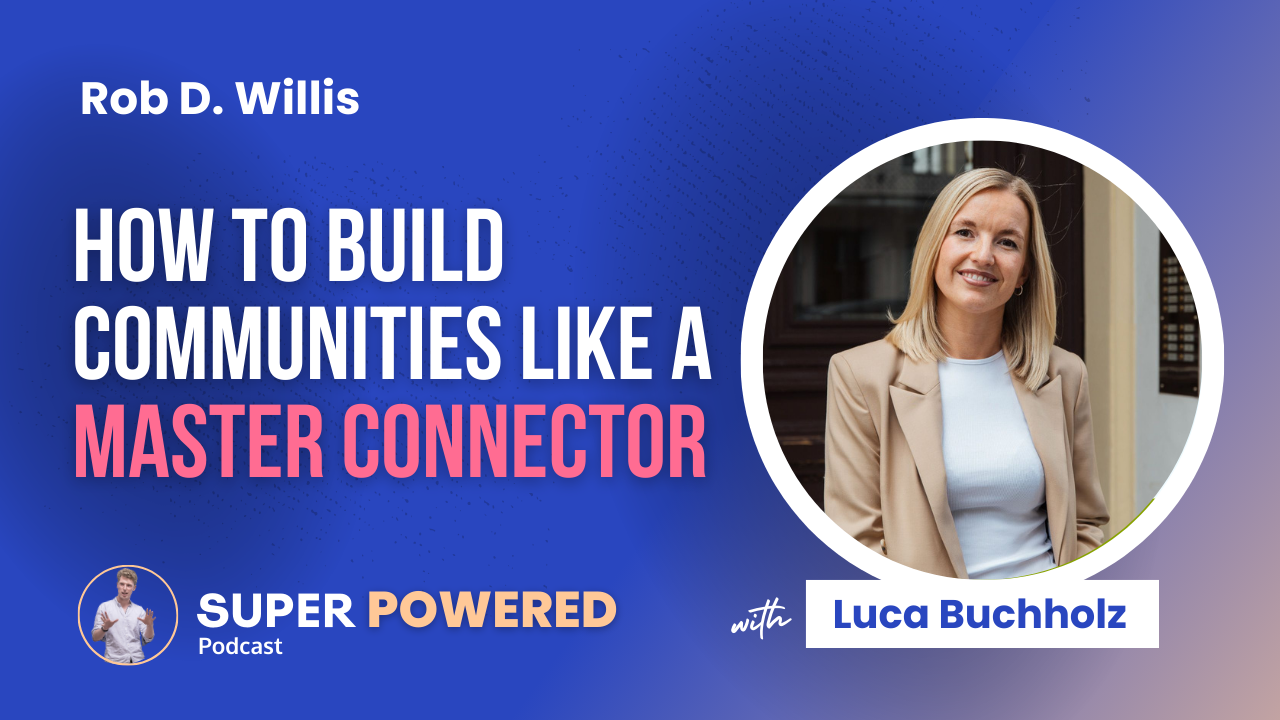
Ever wondered why some teams feel like family while others feel like strangers sharing an office?
Luca Buchholz is a global community architect who has scaled communities from local meetups to worldwide movements. Her counter-intuitive approach reveals that true communities aren't accidental - they're intentionally designed around shared purpose.
From scaling international tech communities at Camunda to building nonprofit organisations, Luca's expertise in creating environments where people genuinely belong has made her a sought-after business coach. She openly shares how a painful childhood experience of exclusion sparked her lifelong mission to ensure everyone feels valued and connected.
Key Talking Points:
- The critical difference between a group and a community: intentional design around a shared purpose that people feel is worth investing their time and energy into
- Why psychological safety, co-ownership and recognition are the three non-negotiable elements needed to foster genuine belonging
- How a community must evolve as it scales, adapting communication channels while never compromising on core purpose and values
- The surprising insight that successful communities should actually transform both their members and purpose over time, not remain static
Links & Resources:
- Luca's LinkedIn: Luca Buchholz
- Business coaching website
- Book Recommendation: "The Art of Gathering" by Priya Parker
- Book Recommendation: "Dare to Lead" by Brené Brown
- Book Recommendation: "The Fearless Organization" by Amy Edmondson
- Podcast: Dare to Lead with Brené Brown
Today's Exercise: The Check-In Question
This simple practice creates psychological safety and builds deeper connections within any group by opening space for authentic sharing beyond just work topics.
- Start your next meeting by asking everyone "How are you feeling today?" and giving space for genuine responses
- Listen actively without judgment to each person's answer
- Alternatively, send a direct appreciation message to a colleague highlighting something specific you value about them
- Notice how these small moments of connection strengthen relationships and build trust over time
Please note : This transcript is automatically generated and provided for your convenience.
[00:00:00]
Luca Buchholz: people want to be involved.
They actually want to feel that they have a saying
We cannot expect people to, you know, like open up and be vulnerable if we don't do that ourselves.
Rob D. Willis: Welcome to Superpowered, the show where we talk to experts who've mastered their skills in the most demanding situations. They show what actually works so you don't have to learn everything the hard way. My name is Rob D. Willis, and this week I'm talking to Luka Buchholz about creating teams where people truly belong and want to contribute.
Luka actually works with organizations like Kumunda, transforming their teams from groups of individuals into thriving communities.
If you've ever wondered why some teams just seem to have that special spark, this conversation will show you some practical ways to build that connection in your own team.
If you haven't done so already, please make sure to subscribe wherever you listen to podcasts and [00:01:00] get ready for this interview with Luca Buchholz.
Hi, Luca. Welcome to the show.
Luca Buchholz: Hi Rob, thank you so much for inviting me. I'm glad to be here.
Rob D. Willis: I'm glad to be here too. I actually saw you speak at the end of last year talking about building communities. And you describe yourself as a natural connector and you're deeply passionate about building meaningful relationships. So I'm really excited to go into some of that stuff today. For listeners who don't know you, though, could you introduce yourself and tell us a bit about how you help people?
Luca Buchholz: Sure, happy to. Well, I work as a business coach and I help leaders and teams shape meaningful work environments and achieve their goals. And I think you just mentioned it, but like everything I do wholeheartedly revolves around purpose and people. This is really something that has always driven me and still drives me.
And I work as a business coach now by my employer. My background is really in [00:02:00] community building and fostering a sense of belonging on a professional level. So I spent several years working in an international tech company as a global community lead. And I really scaled the community there from local to global.
I introduced several community initiatives on a global. Scale. And apart from that, I also collaboratively build with other people, a nonprofit organization. It's called signal solidarity. I was for a long time, part of their board, and we really grew a really engaged internal and external community there.
So I really built communities in all shapes and forms. And really, my experience is that the most impactful leaders and organizations are the ones who not only focus on numbers, but they really create environments where people feel a genuine sense of connection and where they really feel that they belong.
Because when people feel [00:03:00] that they belong they Not only are more engaged and motivated to contribute, but they will really also share their unique perspectives, their talents, and this is really what makes an organization also more innovative and also more collaborative and also more future proof.
Rob D. Willis: That sounds like the dream of most business leaders I can imagine actually, but let's just go back to the real fundamentals here. This may sound too basic, but for you, how would you define a community versus just a group of people?
Luca Buchholz: So, a community is not just a group of people, because community is always built with intention. And what do I mean by that? What do I mean by intention? So, a community always has a shared goal. So a community always starts with a shared purpose and that people feel that this purpose or this goal is so [00:04:00] important that it's worth collaborating.
So that is really something you always start with when building a community. And actually community building really means a lot. fostering and also supporting the individual relationships that then in the end actually make a community. So that's really important. So you will always need this shared purpose and you really support individual relationships as part of a community.
Rob D. Willis: Do you feel there are any other like essential ingredients that you need to have to have a community? We've got purpose or goal. What else do you think might be important?
Luca Buchholz: Yeah, so if you really want to foster a sense of belonging and want to build a community, there are definitely some key elements that you need. And one of the things that is extremely important that there is psychological safety and trust. So that's always the foundation of fostering belonging or [00:05:00] building a thriving community.
Because people really need to feel safe in expressing. their opinions and also contributing. So they should feel that they can express themselves without fear of judgment or exclusion. And this is why psychological safety and trust is really always the foundation of fostering belonging. But also I think one of the things that are extremely important is ownership.
So you really want to build a community, not just for its members, but you really want to build it with them. And maybe one more thing I want to mention here is recognition. So of course I think we all want to feel.
valued and like our contributions matter and this is why recognition is really one of the Foundational key elements that we need in order to foster belonging and build a thriving [00:06:00] community
Rob D. Willis: It's interesting you say that because a few guests on the show have brought up the idea of recognition. The idea that we see the impact of our work, what we're doing, because otherwise it's just so frustrating. It's like completing a crossword every day and not really knowing if you completed it or not, not knowing if you were right. You're sending off all of this work and you're not ever seeing the fruits of it. You're not seeing what, what it was all for, basically. I was, you know, Interesting, because I, I, I wonder what is the place of a leader in a community then? Is a leader essential? Or can a community evolve with no leader?
Luca Buchholz: That's a really interesting question. Definitely a leader has a really important part to play in building a community. Maybe in the beginning phase you don't always need a leader. One leader. Maybe also there are several people who started building a community. So maybe you cannot [00:07:00] always define that there's one leader, but definitely you need to have people who feel responsible for leading the efforts.
And especially when we look into companies leaders play. And really important role in building communities. You can also see maybe your team as a community, right? And then the leader really plays an important role because I think it's really important to realize that it always starts with ourself as a leader, how we show up because.
We cannot expect people to, you know, like open up and be vulnerable if we don't do that ourselves. Right. So I think that is such an important part that we realize as a leader, it always starts with how we show up. And this is something definitely where, yeah, a leader plays a really important role that they really.
Rob D. Willis: Act as a role model, maybe, and also that they build the community with intention so [00:08:00] that they really get people involved, that they really take care of the community members, that they also really actively listen to what the people want, instead of just like, yeah, thinking, Oh, maybe they want this. So let's implement that.
On that note, can we just think about maybe a situation which I imagine is familiar to you as a community builder, because I can imagine that the companies you go into, they have a leader and they feel that they don't have a community. So, what are some of the symptoms that they're seeing which lead them to bring in someone like you?
Rob D. Willis: What should people be looking out for to think that we don't have a community yet?
Luca Buchholz: , I think no one would actually say, Oh, we don't have a community. I mean, maybe people would hear about, like, the buzzword community, and then they would say, Oh, yeah, I want a community. But usually that's not the case. Usually, People, maybe leaders, they realize, okay, people are [00:09:00] not opening up or maybe they're not contributing, or maybe they are not as committed to the goal as they should be.
So maybe these are things that leaders realize without actually thinking, Oh, we need a community. And of course there are different ways to go about that, but definitely. Also seeing it as like building a community can definitely help in order to, yeah, also get actually the team more involved and also to increase the commitment.
For me, I kind of think of it as almost a feeling. You can feel when there's a community there. Or do you see that there are some metrics that you notice cropping up repeatedly when people don't have that sense of belonging?
One of the things that I feel is really important is always That you really establish the goal first and also find out, okay, what is it actually, what makes success for us? Right. So, because only if we know the goals, [00:10:00] then we also know what success should look like. And then we can actually look at metrics.
Luca Buchholz: And yeah, of course, for example, I mean, this is like the question, If you want to talk about like metrics in the sense of metrics that show a thriving community or maybe metrics when a community is lacking or when there is no community, but usually then you would probably attract engagement levels or maybe also quality of connections, retention and growth if you have a community and you want to measure if it's successful.
Rob D. Willis: Yeah, I love what you said there about the first step being to establish the goal and the vision. What I see in lots of companies is leaders have a goal or a vision, but they're not always great at communicating that to their teams. And they sometimes feel that the vision that they have for their investors is the same vision they need to [00:11:00] articulate to their teams. And it's not that you're lying to either. It's simply that you're going to phrase it in a different way. You're going to talk about different things. What do you think are some of the things that you look out for when you're asking your clients about the vision that they have? What are you trying to make sure is there?
Luca Buchholz: So it's really, what I said, it always starts with the purpose and the vision. And I think it's exactly what you just mentioned. Sometimes we feel, okay, but everything is there. We have the vision, we have the values. For example, values are also really important as part of the purpose. And that values are actually important.
Lift, right. And usually leaders feel that it's already clear because they spend maybe a lot of time in, in their, like setting the vision and maybe also even coming up with values. Maybe sometimes they didn't, but then it's really about this missing piece often really building it with the [00:12:00] people together or maybe also getting them involved.
So they really feel the commitment. So. Of course, first I would check, is it actually there? Because some, some companies, they might have a purpose. They have a vision, maybe they even have values, but some of them, they never thought about that and that's fine, but that's definitely then an important step.
Rob D. Willis: And some, maybe they have it, but people don't really feel connected to it because they didn't play an important role in shaping the vision, shaping the purpose and they have. No option in really, yeah, getting invested into that. So that is definitely something really important to look out for. So maybe if it's there, but also do actually people feel connected to it and do they actually have a sense and really investing into it.
There might be some sort of tension. I feel sometimes between this bottom up approach and the needs of the top down. The leadership [00:13:00] have things that they need the company to do. And I'm wondering if that's attention that you've come across in some organizations where we want to build the ownership.
Rob D. Willis: We want people to feel involved, but there are simply things that we have to do.
Luca Buchholz: definitely. It's definitely something. I think it's really common in companies, right? So especially you just talked about investors. I mean, if you have investors, then of course there's also this part where you sometimes also just have to do certain things. And I think that's Also, maybe you even know that people, they won't be super excited about it.
So there's sometimes this tension. And I think it's really important to keep that in mind. But also there, I think, of course, you always have to see like, how much can you share authentically as a leader, but definitely being authentic and also getting people involved, but also Being clear about, okay, maybe there are certain things that we just have to do in a certain [00:14:00] way, but also being transparent about that, I think is super important because people want to be involved.
They actually want to feel that they have a saying in how things work out. And that's super important. And they're being authentic as a leader. I think that is something, what we just talked about before. It's always how you show up, how you communicate. And a lot of transparency and communication is usually really important there.
And there's often the missing piece because a lot of leaders might feel, Oh, okay. Maybe. I don't know. I, I just don't tell it because no one will be excited about it. And that's usually where there is then a lack because people then feel excluded and they feel they don't play an important role. And this is definitely like the transparency and communication part is such a big thing.
Rob D. Willis: Looking back at the organizations you worked with, I believe it was commander when you were scaling. to a [00:15:00] global community and you also have the NGO
that you're working with. Can you recognize maybe some high level phases that you need to go through from not much community to a really strong global community
Luca Buchholz: There's always this beginning phase where there may be just a few members. And usually it's really the starting phase where it's really important to also get individuals involved. Because I think I said in the beginning, you want to build the community with its members.
You don't just want to build it for them. So really getting these. First people involved and really finding out, okay, what do they need? What would it make worthwhile for them to get involved? And really build it with them. So that's usually like the starting phase. And then when you have this also maybe social identity, the values, also the purpose yeah, you will grow the community.
And then usually when you scale the community, of course. More people [00:16:00] get involved. And of course the community changes in a way because this is actually how it's supposed to be. Each member of a community in an ideal scenario influences the community in one way or the other. And yeah, so it's really a dynamic process and community building.
So maybe you have this beginning phase, then more people join. And there are definitely certain things that I feel are really important that they, that you don't compromise on them, even though more people join. So things like your purpose, the values, but also the maybe social identity. But of course once the community grows, you will also need to maybe adapt.
Yeah. For example, communication channels or formats. So for example, when I worked at Camunda and we It grew the community from local to global of course, things change because you have different time zones and [00:17:00] you have different cultures and you have people from all around the world joining the community.
And of course, then maybe in the beginning phase, we always met in Berlin in a small group, or we were all in the same time zone. And of course that then changes and you have to adapt to it. But. As I said, there are certain things you shouldn't compromise on and yeah, I think these are just like phases.
You really, it's, it's just a really dynamic process, but I think it's really important that yeah, the community is always involved in that.
Rob D. Willis: When you were building this community in Commando and it was the the small team, the happy few in Berlin, and I guess it's like a bell curve, isn't it? You've got the early adopters. How did you create the purpose and identity? Is there exercises you do? Or is it a tradition that you build up? How did you approach that?
Luca Buchholz: So when I joined back in the days, the There was already a community. So I [00:18:00] didn't do that there in a way, of course we, we did it in, in various formats, but like maybe also with other clients I work with definitely in the beginning phase, it's also about establishing a purpose and really thinking about what is actually the goal of this community and why are we all here and why do we even need it?
Because maybe sometimes the answer will also be. Actually, we don't need it because there's no important purpose behind it, and then it won't be worthwhile for anyone to actually invest time and resources into it. So really in the beginning phase, thinking about why is it actually needed? What is the purpose?
And what creates meaningful value to people that they really want to invest time and resources? It's something Really important. And yeah, you can do several exercises to establish the purpose, establish values, really identifying the goal. And that is definitely an important step in the beginning phase.
Rob D. Willis: I love as a [00:19:00] facilitator, I love hearing exercises. Have you got a good one?
Luca Buchholz: there are actually a lot of great exercises. . It really depends also on the size of the group. I think there are different formats I like to work with. There's for example, the for all exercise. I don't know if you know it. And actually it also works really well for establishing a purpose because usually a purpose is also influenced by each individual.
So really thinking about. For yourself and the first phase about what is actually my purpose when it comes to, comes to this company, comes to this community, and then really thinking about it for yourself and then coming together in pairs of two, and then talking about that, and then in the end, bringing it together in the big room.
I think that is actually an exercise I really like to do because it really gives everyone. The opportunity to participate. Of course there were [00:20:00] also other exercises I like to do, but that's definitely one of the exercise I, I like to do with my clients.
Rob D. Willis: That's a good one. Liberating
structures. I believe it's one of the structures they have. What's cool is that also sometimes something will come out which is totally surprising, but works. Have you got a happy, surprising thing? It doesn't have to be with Kumunda, but something which came out which you thought, wow, that is actually brilliant. And what was it?
Luca Buchholz: To be honest, so many things. I think it's just, it's just. So incredible when you really give people ownership, then what comes out of it, because when people really feel this deep connection, the sense of belonging, and also are really committed to the purpose, then they will be so motivated to actually contribute.
And I had it so many times that people just came up with [00:21:00] really Brilliant ideas or that they really established things. So for example, back in the days at Kamunda, I also introduced a program, which was about that people build their own local communities all around the world, because of course you, as a company, you cannot do that all on your own.
So we build a. Program where we actually gave people the opportunity to build their own local communities all around the world. And sometimes I saw photos of videos or whatever, and it was so amazing what people came up with and yeah, how they, how much passion they put into building their own local communities.
So I think it's really about the sense of ownership that people then feel super motivated to do amazing things.
Rob D. Willis: , I've seen that actually with a few companies and organizations and Each of these sub communities have very much their own identity. And I, I think that makes the overall community far [00:22:00] more robust. But you said, and I'd love to dig into this. You should not lose your sense of purpose as you're scaling.
Have you got a time maybe where you feel the purpose was jeopardized? It doesn't have to be serious, but the purpose was being lost slightly and how do you bring things back on course?
Luca Buchholz: Yeah, I think sometimes in the beginning phase, you have a really clear sense of purpose. People are really motivated. And then maybe there comes a time where actually you maybe still the purpose hasn't changed, but maybe people lose sight of it. So I think it's also not a. One time thing, right? You don't introduce a purpose and then you say, okay, that's it.
There's like this symbiotic relationship in a way. So the people will always influence the purpose and purpose Will always drive people or [00:23:00] will always yeah, people will, will just bring the purpose to life. So one influences the other, and this is also how it should be. So a community should always evolve.
A purpose should always evolve because once new people join, they will also. Yeah. Influence the purpose and the purpose will influence the people. And also, I think it's really important, like a community is always, should always be a transformative. experience. So usually people join a community because they want to get in one way from A to B.
So it should be kind of a transformation. And this is also why people in an ideal scenario as part of a community that they will transform in one way or the other, And also maybe the purpose will evolve over time, and that's actually how it should be. But it's just really important to always check in on it again, and to also have maybe opportunities where you can [00:24:00] reconsider if it's actually a right fit.
Rob D. Willis: . So purpose sounds like it is really the. most essential part of all of this. And I think a purpose much like a community can be a feeling, but when you're encoding a purpose, what does it have to look like at the end? When you craft a. Purpose are there essential ingredients? Or what does it have to look like to make sure that it is encoded and scalable?
Luca Buchholz: Yeah, so I think when you really work on the purpose, maybe for the company, for the community, it's always really important that you think about what is actually the goal and why are we here and why are we actually investing time and resources into this initiative or whatever it is. And this is definitely something that you also should have as part.
Rob D. Willis: Of your purpose. That [00:25:00] really tells people like, okay, this is why we are here. This is like the bigger picture because we always want to be invested in something. Yeah. Bigger than ourselves and the purpose statement or whatever it is should always reflect that. But also I think it's really important what we already talked about, that it's not just like the purpose that it's one sentence and people don't live by it, but it should be really something that you always check in on and that you really feel that it's also enforced to live by it and that it really connects with the people who are part of this community.
Let's go back a little bit earlier to before you were working so directly with communities. And I'm wondering if there were early experiences in your life which maybe made you think, Hey, I want to build communities because not everyone wakes up with that, with that purpose in life.
Luca Buchholz: That's [00:26:00] true. I actually thought about it like previously, why this is something that I'm doing. And I think I have always been in a way a community builder at heart. So it was kind of like part of my purpose before it was my job or my profession. And yeah, I think when I thought about it. Maybe a deep answer there is maybe that like back in the days when I was a child like really early on It was just a really short period of time, but in school.
I was Excluded for a little while. So I really felt like an outsider But it wasn't it was really just a short period of time and it was also maybe not That That bad, but really this experience showed me like, how does it feel to not be long? And it was really
for me and transformative experience. And I think after that, I always really, it [00:27:00] was really important for me to belong, but also to make other people feel included.
So I think this was maybe like a big part in my, in my journey of like, actually, before it wasn't my profession to also force the belonging and. Get people together and I think, I mean, sometimes life works in mysterious ways, right? Because I know, like, I think after I had my maybe first job, I I know that I reflected.
I did some self reflection work and I said, okay, what do I want to do? In my next job or with my life, I actually wrote things down and it was a lot about, a lot human centric work. And actually I thought to myself, and I know this still, like I thought to myself, Great, Luca, this is actually really nice that you wrote all of this down, but this is not a job.
Because, like, back then, especially in Germany, community building wasn't a thing at all. No one talked
about it. And yeah, I mean, life works [00:28:00] in mysterious ways, so at some point, like, I just Saw the job and it actually included all of the things I wrote down. And I thought, okay, maybe that that's what I should do now.
So, yeah, I think I have always been a community builder at heart, but definitely yeah, at some, at some point it came my profession and this is actually always really funny how life works.
Rob D. Willis: what was the job you were doing before that made you provoked this brainstorm, which led to the purpose being
found?
Luca Buchholz: I, I was, I mean, my background is in communication and marketing. So back in the days I worked more in that field and I always liked it, but like always when I like reflected on what did I like most about my jobs, it was always this human centric part. And I think in my intro, I also said I was always really driven by People and purpose.
And I think like, when I look at all the things [00:29:00] I did in my life, this was, these two things were always the main drivers
Rob D. Willis: so I actually feel marketing and communication is entirely human,
because
we're communicating with people. So I'm wondering specifically what bits did you feel you got to flex those muscles most of the job that you did. Were you a copywriter? Were you a creative director? Like what, what kind of things were, were you doing in marketing?
Luca Buchholz: Yeah, actually my jobs, they always had this community part in it. I, I, no one would have called it like that back in the days, but definitely it was always part of it. So for example, I did marketing communications. Well, so was responsible for events and also a lot of branding. So, and as you said, I mean, it's all human centric.
Right? Because in its core, it's all about people. And this is why you're doing it, actually, or who you're doing [00:30:00] it for. So I always did these kind of things, but you would never call it like community building, maybe back in the days, but it was always part of what I did when I look back. So, I mean, I think always.
Like in retrospective, things always make sense. And I think this is also like now as a business coach, it's so interesting when working with people and finding out more about their stories. It always makes sense. And I also always tell them like when, when people maybe are in this like state where they don't know what to do next, I always say like, you know, one year from now things will really make sense.
Yeah. You, you will actually get it why you're now doing this or why you're in this phase, because like in retrospective, usually the things that you did, they always make sense in a way.
Rob D. Willis: Yeah, there's that famous speech at Stanford by Steve Jobs when he's looking back on the things that interested him when he was studying. Somehow they all came together and led to him [00:31:00] having this unique perspective that allowed him to drive forward Apple in the way that he did. I'm wondering when you were working in marketing, is there a particular skill or a practice that was drilled into you then which you still find helpful today?
Luca Buchholz: Probably a lot of skills because I think for me, it was a lot, always about like understanding what drives people, what motivates people to maybe also purchase something, right? That is definitely something that I was always interested in, but also really measuring success.
I think that is. Really important in every part, like in every job and one way or the other. So I think that is definitely something I did back then, which I'm still doing nowadays, because as we discussed before, I think you always need to like establish the goal and then really measure, measure success.
And that is definitely something I [00:32:00] already did back then.
Rob D. Willis: If you were to look back now, you said everything makes sense in retrospect. If you were to look back now on your journey from the young girl, who felt excluded, who started building communities as a child, to the woman who's a business coach, who works with companies and builds communities. If you were to write a book about that journey, what do you think you would call it?
Luca Buchholz: I think I would call the book probably work in progress.
Rob D. Willis: Makes sense. It's something, as you say, which is, starts off with the early adopters. You feel you have a crystal clear idea, but then it needs to adapt and change and refine hopefully not losing sight of that drive and that
perspective that you had at the
Luca Buchholz: Yeah. And I think we, we are all like, as individuals, we are work in progress. Communities are work in progress. Everything we are doing in life is work in progress. And I think that's actually the nice thing that all is [00:33:00] dynamic and that it will keep evolving and that I think is actually the nice thing about life and work in general.
Rob D. Willis: Can we move to some rapid
fire?
have you got a good book recommendation about community building and creating belonging?
Luca Buchholz: Definitely. Can I also name three or only one?
Rob D. Willis: You can make name
Luca Buchholz: I will, I will, name three because actually there are three that definitely come to mind. So first of all, I would definitely recommend The Art of Gathering by Priya Parker. It's really about creating intentional spaces. So I think it's a must read when it comes to community building.
Also, one of my favorite authors, Ever Brene Brown, she wrote Dare to Lead. There's also a podcast so I would definitely recommend that, and I think for every leader also when it's about psychological safety and how it impacts team performance and belonging, I would recommend the [00:34:00] Fearless Organization by Amy Edmondson.
Rob D. Willis: you got maybe an example of the best companies that model community building?
Luca Buchholz: I think, I mean, there are so many different kinds of communities, but definitely one of my favorite. favorite. examples ever, I think is Notion because they really did such a great job. I think not everyone knows about it, but they really build their organization with the community. The community is so invested that they create templates.
They're ambassadors. So it's really a community led company. And it's yeah, I think they're really doing great when it comes to community building.
Rob D. Willis: Yeah, I've been to a few of their events in Berlin. Matthias Frank, I think runs them does a really good job with that. let's move on to the listener challenge. So in this part of the pod we give listeners a simple exercise or a ritual that they can try out for the next week to [00:35:00] get a little bit of your superpower. What have you got for us, Luca?
Luca Buchholz: So I think, because we said that it's really important to force of psychological safety and trust. So it's really important to also show that you deeply care about people, maybe not just on a professional level, but also more on a human level. So definitely one of the things. The things that I love doing is always starting a meeting with a check in question.
So maybe you can ask someone like, or the whole group, how are you feeling today? And I mean, this is not a big thing, but usually like it opens the conversation for maybe more meaningful conversations afterwards and everyone can say something. And maybe if you're not a leader and you're not hosting meetings, maybe you could send a little appreciation message to someone, either a colleague, a.
Friend or yeah, someone else and maybe send [00:36:00] them like an, yeah, a nice message about something you really appreciate about them, or maybe something that they've done that you want to recognize. Because what we talked about recognition and appreciation is so important. And we really want to feel that what we do matters.
So these are maybe two things you could do today.
Rob D. Willis: Awesome stuff. Well, we definitely appreciate you coming on the show, Luca. Where can people go to find out more about you?
Luca Buchholz: You can definitely check out my LinkedIn page. You can also connect with me there. Feel free to send me a message. I also have a website and it's really easy to find it. But yeah, you can reach out to me on LinkedIn if you want.
Rob D. Willis: Awesome stuff. We'll link to your profile in the show notes. Thank you for coming on the show,
Luca.
Luca Buchholz: you so much. It was a really nice conversation.
Rob D. Willis: That was Luca Buchholz. And what struck me most about that conversation was how community building isn't about gestures from leadership. It's about [00:37:00] creating the right conditions for people to take ownership. When you give them space to contribute authentically and connect with a shared purpose, that's when amazing things happen.
If you found today's conversation valuable, please just take a minute to leave us a review. wherever you listen to podcasts. And if you know someone who's leading a team and wants to build that connection and community in their organization, send them this episode. I reckon that Lucas Perspective will be just what they need.
I'm Rob D. Willis, and I'll see you next week for another episode of Superpowered.
Subscribe to the Podcast!